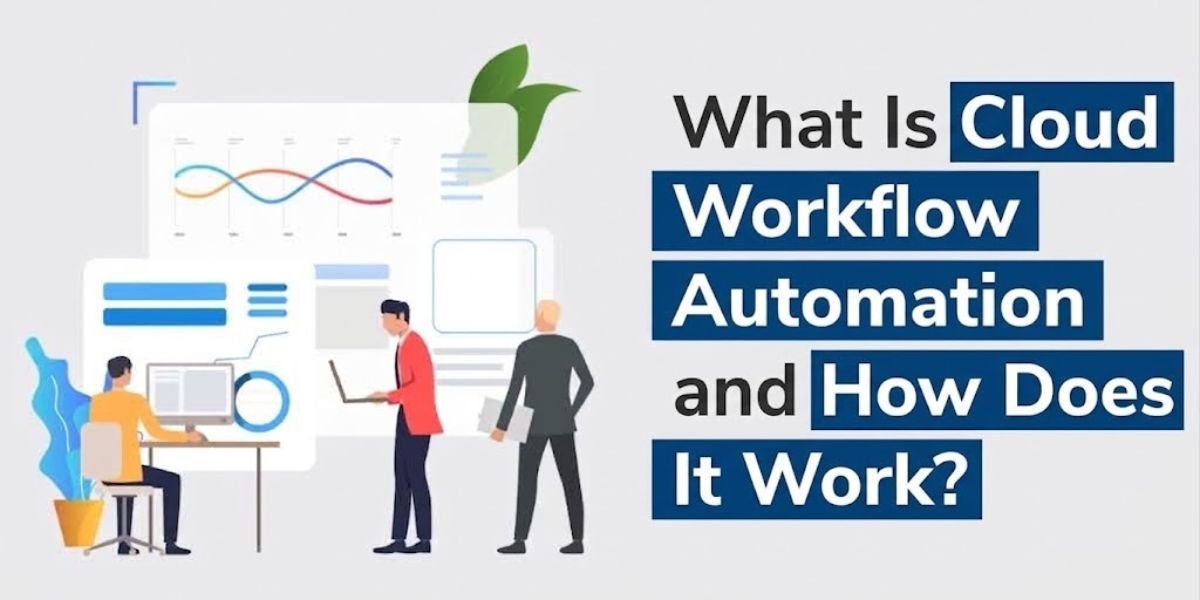
Work rarely stays inside one application. A customer inquiry may begin on a website form, move into a CRM, trigger an email notification, create a sales task, and eventually reach an invoicing or customer support platform. When team members handle every single handoff manually, operations slow down and critical data slips through the cracks.
Cloud workflow automation solves this operational bottleneck by connecting these separate systems through web-based technology. It creates automated pathways that pass information between applications, execute specific tasks, and apply business logic without needing constant manual intervention.
Understanding how this technology functions allows organizations to move away from tedious data entry and focus on higher-value operations.
What Is Cloud Workflow Automation?
At its core, cloud workflow automation is the technology-driven orchestration of multi-step business processes across internet-hosted applications and services. To fully grasp the concept, it helps to break down its three essential components.
The cloud refers to remote servers, software, and databases accessed over the internet rather than on local computers or physical office servers. A workflow is a defined sequence of tasks, decisions, and data movements that complete a specific business objective. Automation is the execution of these steps using software rules instead of human effort.
Combining these elements creates an interconnected environment where software applications communicate with each other automatically.
A single automated task, like sending a scheduled email broadcast, is not a complete workflow. A true cloud workflow connects multiple distinct steps and determines what should happen next based on an event, a specific condition, or a calculated result.
For instance, when a client signs a contract online, a cloud workflow can simultaneously save the signed document in secure cloud storage, generate an invoice in accounting software, notify the account management team on Slack, and create an onboarding task in Asana.
What Makes It a Cloud Workflow?
What sets a cloud workflow apart is its ability to bridge disparate, internet-hosted platforms seamlessly. Cloud workflow automation natively connects:
- SaaS applications such as Salesforce, HubSpot, and Zendesk
- Cloud databases like Amazon DynamoDB, Google BigQuery, and Snowflake
- APIs that expose system features to external applications
- Online forms and customer portals
- Cloud storage services including Google Drive, Dropbox, and AWS S3
- Business systems for ERP, payroll, and project tracking
- Internal and external services running across different vendor platforms
The cloud environment changes how workflows operate by removing physical location dependencies and software installation barriers. Because these workflows run on cloud infrastructure, they operate continuous 24/7 cycles without relying on a specific local computer staying turned on. They also scale effortlessly, processing 10 transactions or 10,000 transactions with equal reliability.
This contrasts sharply with traditional, on-premises workflow tools. On-premises software usually depends on locally installed programs, internal network servers, and custom scripts tied to physical hardware. Upgrading local systems, connecting to external software, or providing remote access often requires complex network configurations and heavy IT overhead. Cloud workflows eliminate these constraints by utilizing standardized web interfaces that connect platforms across the globe in real time.
How Does Cloud Workflow Automation Work?
A cloud workflow functions as an interconnected sequence where every stage depends on the outcome of the preceding step.
The entire process begins when an initial event occurs in a connected system. This event triggers the workflow, prompting it to extract relevant information and evaluate predefined business logic. The system checks conditions to determine the correct path forward, carries out specific actions across multiple platforms, and moves updated data to its final destination. Throughout the run, the platform records the execution result for auditing and monitoring purposes.
Understanding the internal components of this sequence highlights how cloud workflow platforms deliver high performance and precision.
The trigger that starts the process
Every automated workflow requires an initial spark called a trigger. A trigger is an event or condition that signals the workflow engine to begin execution. Common triggers include:
- Form submissions on a public website or internal intake portal
- Payment processing events recorded through services like Stripe or PayPal
- File uploads to cloud repositories like Dropbox or Google Drive
- Database record updates, such as a status changing from Pending to Approved
- Incoming messages or emails arriving in a monitored inbox or communication channel
- Scheduled time intervals, such as running a report every Monday at 8:00 AM
- API requests sent from third-party systems via custom code
The rules that decide what happens next
Once triggered, the workflow uses business rules to analyze data and route tasks correctly. These decision structures rely on logical operators to keep work moving in the right direction.
Filters ensure the workflow processes only data that meets specific criteria, ignoring irrelevant triggers. Branching logic sends information down different pathways depending on factors like order value, customer location, or product type. Approval steps pause the automated flow to request human authorization before proceeding to sensitive actions. Decision logic evaluates incoming values using if/then parameters to select the correct next step dynamically.
The actions that move the work forward
Actions are the active steps executed by the workflow engine after evaluating the trigger and business rules. An action carries out work inside connected applications.
Standard automated actions include pushing real-time notifications to Slack or Microsoft Teams, creating new customer entries inside a CRM, updating inventory totals in an ERP, making custom API calls to external services, moving and renaming documents in cloud drives, and assigning project tasks to specific employees. A single workflow often executes several actions in sequence across different applications.
What happens when a step fails
Automation is not a flawless, hands-off process. Network timeouts, rate limits, invalid data formats, and API outages can disrupt execution at any time.
Professional cloud workflow tools include dedicated error-handling features to maintain operations when failures occur. Automatic retries resubmit failed requests after short delays to overcome temporary network glitches. Error alerts immediately notify administrators via email or chat when a workflow encounters an unexpected error. System logs record execution histories, error codes, and payload data to help technical teams diagnose problems.
Fallback actions route failed tasks down alternative paths, such as assigning a manual ticket to a staff member if an API call fails. Human intervention capabilities allow managers to pause, fix, and rerun failed workflows without losing input data.
A Simple Example of Cloud Workflow Automation
A classic application of cloud workflow automation occurs within sales operations when managing incoming sales leads.
When a potential client fills out a contact request on a company website, the form platform triggers a workflow. The system instantly creates a lead record inside HubSpot or Salesforce.
Next, conditional logic evaluates the lead details based on company size, job title, and geographic region. If the lead score falls below a set threshold, the workflow assigns the contact to an automated nurture email campaign.
If the lead score meets or exceeds the threshold, the workflow takes immediate action:
- It assigns the prospect to an available sales representative based on territory rules.
- It sends an instant notification to the rep via Slack with contact details and form responses.
- It sends a personalized confirmation email to the prospect with an embedded calendar link for scheduling a call.
- It creates a follow-up task with a 24-hour deadline inside the CRM for the assigned account executive.
The automated system handles all data transfers, notifications, and record creations within seconds. The human salesperson steps in only when it is time to conduct the discovery call and negotiate terms, allowing them to focus entirely on closing the sale.
Where Businesses Use Cloud Workflow Automation
Organizations use cloud workflow automation to remove administrative bottlenecks across almost every business operational unit.
In sales and lead management, workflows assign new prospects, update pipeline stages, and route contracts for electronic signatures using platforms like DocuSign.
Customer support teams use workflows to analyze incoming support tickets, tag issues by urgency, and route high-priority cases directly to specialized engineering groups.
Finance and approval departments automate expense report approvals, invoice matching, purchase order processing, and late-payment reminder notifications.
HR teams streamline employee onboarding by using workflows to automatically provision software accounts, generate welcome documentation, and schedule training sessions on employee calendars.
Document and data management workflows ingest uploaded files, run optical character recognition to extract key text, rename files according to corporate naming conventions, and route documents to secure cloud storage locations.
IT operations leverage workflows to automate password resets, manage user access permissions across SaaS suites, and execute routine system health checks.
Security teams set up automated incident response workflows that detect unauthorized login attempts, isolate compromised user accounts, and notify security teams on call.
Cloud Workflow Automation vs. Cloud Automation
While these terms sound identical, they refer to different layers of business and IT management.
Cloud automation is a broad discipline focused on managing cloud infrastructure, hardware resources, and platform environments. It involves automated server provisioning, infrastructure scaling, software deployments, database backups, network configurations, and security patch installations. System engineers and IT administrators use cloud automation tools to maintain server infrastructure stability.
Cloud workflow automation operates at a higher application level. It coordinates sequences of business actions, data movements, and human tasks across software applications, SaaS products, and business units.
To illustrate the difference, consider a corporate data platform:
Using cloud automation, an IT system provisions a new database cluster on AWS, configures network firewalls, and applies security settings automatically.
Using cloud workflow automation, a business platform waits for a customer to complete a purchase, extracts the transaction details, updates the customer balance inside that database, generates a PDF receipt, and emails the customer a confirmation.
The Systems Behind a Cloud Workflow
Cloud workflow platforms rely on three core technical mechanisms to exchange data reliably across applications: connectors, APIs, and webhooks.
Connectors are pre-built integration modules designed for specific software applications. They hide underlying technical complexities behind user-friendly interfaces, allowing non-developers to link applications like Shopify, Mailchimp, and Google Sheets without writing code.
APIs (Application Programming Interfaces) serve as the underlying communication protocols that allow applications to request actions and transfer data. Cloud workflow engines interact directly with software APIs to retrieve, create, or update records.
Webhooks are automated, event-driven messages sent from one application to another the instant something occurs. Unlike traditional polling methods that check for updates every few minutes, webhooks push real-time event notifications immediately.
These technical elements work together within a single workflow sequence:
An e-commerce purchase takes place on a website. The payment processor uses a webhook to send an instant payment alert to the workflow platform. The workflow parses the payload and uses an API call to query inventory software, verifying item stock levels.
Next, a pre-built CRM connector updates the customer purchasing history, and an email service API dispatches a receipt to the buyer. Finally, a notification connector alerts the fulfillment warehouse team on Slack to prepare the order for shipment.
What Cloud Workflow Automation Does Well and Where It Falls Short
Implementing automated workflows offers real operational improvements, but it is not a fix for broken operational strategies. Understanding its strengths and limitations prevents costly deployment mistakes.
Core Strengths
- Eliminates manual handoffs between teams and standalone applications.
- Dramatically reduces data entry errors caused by manual copy-pasting.
- Accelerates business operations, running tasks in seconds instead of days.
- Keeps information synchronized across separate software systems.
- Enforces standardized rules, ensuring corporate compliance on every execution.
- Scales processing volume without requiring proportional headcount increases.
Operational Limits
- Badly designed processes remain bad, automating a broken process only speeds up bad results.
- Integrations can break when vendor systems experience downtime or software bugs.
- API changes by software vendors can disrupt established workflows without warning.
- Poor input data produces poor output data, corrupting linked downstream systems.
- Complex or sensitive business decisions still require human oversight and judgment.
- Workflows require active monitoring, governance, and long-term ownership.
Which Workflows Are Worth Automating?
Not every process should be automated. Evaluating candidate processes against specific criteria ensures a high return on investment before building workflows.
Ideal candidates for cloud workflow automation share consistent characteristics:
- High repetition: Tasks performed dozens or hundreds of times each week.
- Predictability: Processes that follow clear, standardized, step-by-step logic.
- Rule-based nature: Operations governed by explicit conditions without subjective interpretation.
- High volume: Data transfers that consume significant staff hours manually.
- Multi-system dependencies: Workflows requiring data input across three or more platforms.
- Error sensitivity: Tasks where human typos cause financial or operational friction.
Conversely, processes that undergo frequent updates, rely heavily on human empathy, require complex negotiations, or occur rarely are poor candidates for automation. Attempting to automate highly variable tasks creates brittle workflows that break under changing real-world conditions.
What to Check Before Putting a Workflow Into Production
Deploying an automated workflow directly into a live production environment without testing can disrupt core business operations. Reviewing key technical and operational factors prevents service interruptions.
Before deploying a workflow, evaluate these critical areas:
- Process mapping: Document every step, edge case, and decision logic path clearly.
- System permissions: Verify that system authentication keys use least-privilege security access.
- Data sanitization: Ensure the workflow validates, reformats, and cleans input data properly.
- Error and failure routing: Test how the workflow responds when an API is offline or returns invalid data.
- Security and privacy standards: Confirm data handling complies with regulations like GDPR or HIPAA.
- Rate limits and operational costs: Confirm that workflow execution volume will not exceed API rate limits or generate unexpected platform usage fees.
- Long-term ownership: Designate a team member to monitor execution logs and maintain integrations over time.
Assigning explicit ownership is essential. Without a dedicated owner to update APIs, monitor error logs, and adjust rules as business needs evolve, automated workflows eventually fail silently.
Cloud Workflow Automation Tools
The software landscape for cloud workflow automation spans several operational categories, each tailored to distinct technical requirements and organization sizes.
Business automation platforms cater to non-technical users and department teams. Tools like Zapier and Make offer visual drag-and-drop interfaces and large libraries of pre-built app connectors, allowing teams to construct workflows without coding experience.
Integration platforms (iPaaS) serve mid-market and enterprise operations that require advanced data transformations, strict security compliance, and high throughput. Leading platforms include Microsoft Power Automate, Workato, and MuleSoft.
Cloud-native workflow services provide developer-centric orchestration tools natively integrated into public cloud ecosystems. Services like AWS Step Functions, Google Cloud Workflows, and Azure Logic Apps allow developers to build durable, highly scalable application workflows using code or configuration files.
Developer-focused orchestration platforms like n8n and Temporal target technical teams needing custom code execution, self-hosting flexibility, open-source architectures, and advanced error handling for complex backend operations.
FAQs
Is cloud workflow automation the same as process automation?
No, though they are related. Process automation is a broad business category that includes any technology used to automate business operations, including legacy on-premises tools and physical machinery. Cloud workflow automation specifically refers to orchestrating software tasks, data flows, and application events across cloud-hosted platforms using internet protocols.
Does cloud workflow automation require coding?
Not necessarily. Modern visual automation platforms allow teams to build complex multi-step workflows using drag-and-drop interfaces, pre-built connectors, and visual logic builders. However, enterprise-grade workflows and custom cloud applications often leverage code snippets, JSON configurations, and custom REST API integrations to handle advanced business logic.
Can it connect different SaaS applications?
Yes. Connecting separate, third-party SaaS applications is one of the core functions of cloud workflow automation. By utilizing native web APIs, webhooks, and pre-built system connectors, workflow engines pass data securely between platforms like Salesforce, Zendesk, Google Workspace, Slack, and QuickBooks.
Is cloud workflow automation secure?
When configured correctly, cloud workflow platforms maintain robust enterprise security. Reputable vendors use end-to-end data encryption in transit and at rest, adhere to compliance standards like SOC 2 Type II, GDPR, and ISO 27001, and support centralized access management through Single Sign-On (SSO). Security risks typically arise from misconfigured user permissions, overly permissive API keys, or poor data handling within custom workflow steps.
What happens when an automated workflow fails?
When a step fails, a properly designed workflow executes preset error-handling rules rather than quietly dropping data. The system can automatically retry the action after a brief delay, route the data to an alternate fallback path, log the error details for analysis, and notify an administrator via email or instant message. Human operators can then review the stalled transaction, resolve the underlying issue, and resume execution without losing data.