Financial data has quietly become one of the most valuable assets an organization owns. Every payment, invoice, loan, investment, tax record, and customer transaction contributes to a growing stream of information that influences high-stakes business decisions. The modern challenge is no longer collecting that data. It is turning raw transaction logs into accurate, secure, and actionable intelligence.
Banks, fintech companies, accounting firms, and enterprises now rely on integrated technology stacks that process financial information faster, reduce manual labor, detect risk instantly, and provide absolute clarity on cash flow. This structural shift has permanently changed how organizations manage capital, maintain regulatory compliance, and deliver services to users.
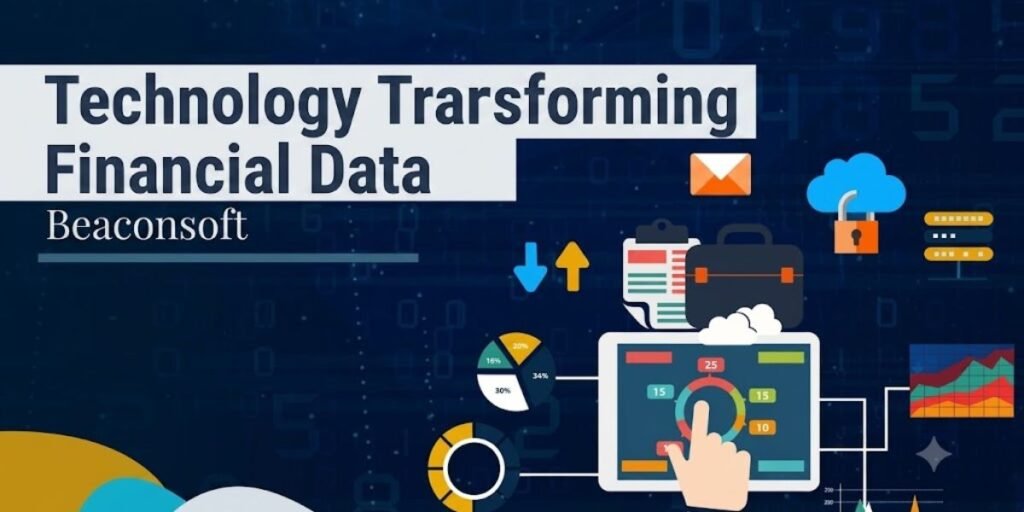
The core narrative around technology transforming financial data, as referenced in foundational frameworks like Beaconsoft, highlights secure financial data sharing through Open Banking APIs and advanced encryption. While this explains how financial information moves safely between authorized parties, it represents only one component of a much larger technical architecture.
Modern financial systems combine distributed cloud infrastructure, artificial intelligence, deep predictive analytics, intelligent process automation, immutable ledgers, and zero-trust cybersecurity protocols. These technologies work together behind the scenes to transform fragmented data points into real-time operational advantage.
Analyzing the Beaconsoft Foundation: Financial Data Sharing
The initial scope set by Beaconsoft focuses primarily on financial data sharing and the baseline technologies that make secure information exchange possible.
Open Banking APIs allow customers to grant explicit permission for financial institutions to share selected account information with approved third-party applications. Instead of manually downloading static bank statements or manually inputting credit details, consumers and businesses connect budgeting tools, tax platforms, and enterprise accounting software directly to their primary accounts.
Security forms the operational core of this data movement model. Strong encryption protocols protect financial records during storage and active transmission. Because financial records contain sensitive identifiers, secure data sharing depends on multi-layered defenses designed to block unauthorized access, identity spoofing, and data interception.
Practical applications extend well beyond corporate finance. Everyday tools like joint savings accounts, personal wealth management software, and instant merchant underwriting rely on these direct lines of communication. Businesses analyze customer transaction trends to optimize service delivery, while individuals gain instant visibility into spending habits, credit profiles, and long-term financial planning goals.
While secure data sharing solves the problem of information mobility, it leaves out the broader operational infrastructure required to process, interpret, and defend that data once it arrives at its destination.
Why Financial Data Is Modern Business Capital
Financial information is no longer a static ledger used exclusively for tax reporting or yearly accounting audits. Organizations leverage real-time financial data pipelines to solve operational bottlenecks and answer high-impact business questions instantly.
When evaluating product margins, teams cross-reference real-time vendor costs with sales velocity to determine true profitability. To understand customer lifetime value, platforms pinpoint historical purchasing habits to project long-term retention and revenue potential.
Internal operations also benefit directly. Automated analysis uncovers subscription overlaps, idle resources, and unauthorized department expenditures. Simultaneously, real-time risk mitigation systems flag fraudulent account activity within milliseconds, while liquidity engines calculate precise cash availability for upcoming financial obligations.
Answering these operational questions requires direct integration between secure transfer layers and deep-processing technologies capable of handling massive volumes of structured and unstructured financial records.
Open Banking APIs: The Mechanics of Secure Data Transfer
Open Banking has structurally altered how financial data moves across corporate boundaries. Instead of keeping user account details isolated within legacy bank databases, application programming interfaces allow authorized applications to retrieve specific data points once customer consent is granted.
This direct technical bridge serves consumers and corporate entities simultaneously.
For individual users, APIs connect budgeting platforms, aggregate accounts from multiple banking institutions into unified dashboards, automate expense categorization for tax preparation, and streamline credit verification during loan applications.
For commercial enterprises, these integrations automate operational verification steps:
- Instant bank account verification for direct debit setups
- Complete elimination of physical documentation and manual entry errors
- Faster credit underwriting for commercial lending applications
- Embedded payment mechanisms operating directly inside standard business software
Because explicit user consent remains the mandatory key, customers retain total control over which platforms access their financial records, for what purpose, and for what specific timeframe.
Artificial Intelligence and Pattern Detection in Financial Datasets
Enterprise organizations generate millions of financial micro-transactions across international borders every single day. Reviewing these massive datasets through manual human audits is impossible and significantly elevates the risk of costly oversight.
Artificial intelligence models analyze vast financial pipelines in real time, uncovering deep systemic patterns and anomalies that humans cannot catch.
Banks deploy machine learning algorithms to evaluate behavioral telemetry during online transactions, instantly flagging stolen cards or compromised accounts. Lenders evaluate transactional health alongside traditional credit scores to make faster, fairer underwriting decisions. Corporations deploy AI models to forecast quarterly revenue, monitor departmental spend variations, and identify supply chain pricing changes before they impact the bottom line.
By handling heavy analytical processing, AI allows financial directors and risk managers to focus on high-level strategic decisions rather than manual data discovery.
Machine Learning: Adaptive Risk and Underwriting Models
Machine learning extends basic artificial intelligence capabilities by continuously refining its algorithmic models as new transactional data flows through the system.
Static rule sets fail when bad actors alter their techniques or market conditions shift unexpectedly. Machine learning algorithms adapt autonomously by recognizing subtle variations in user behavior and market mechanics.
Financial institutions deploy adaptive machine learning across several core functions:
- Detection of complex money laundering schemes and unauthorized account access
- Continuous credit risk evaluation based on real-time cash flow metrics
- Automated customer segmentation to tailor wealth management products
- Rapid loan approvals for micro-lending and working capital lines
- Execution of high-frequency trades based on market sentiment and data fluctuations
As total transaction volume grows, these models become systematically sharper, continuously reducing false positives in fraud detection while opening access to credit for creditworthy applicants.
Cloud Infrastructure: Speed, Scale, and Operational Agility
Legacy financial infrastructure relied heavily on dedicated local servers housed inside locked corporate data centers. These systems required constant hardware maintenance, long deployment cycles for software updates, and expensive physical scaling strategies.
Cloud platforms have rewritten this model by offering secure, on-demand compute and storage capabilities tailored specifically for regulated financial operations.
Modern cloud deployments provide dynamic scalability to handle peak processing loads, such as end-of-month payroll runs. They feature distributed real-time data replication for zero-downtime disaster recovery alongside accelerated software deployment cycles using containerized infrastructure.
Furthermore, cloud systems reduce physical hardware maintenance costs while unifying data availability across globally distributed business locations. Leading accounting suites, enterprise resource planning platforms, and digital banking applications operate natively on dedicated financial cloud environments to ensure consistent uptime and regulatory compliance.
Big Data Analytics: Transforming Raw Transactions into Strategy
Every swipe of a credit card, incoming supplier invoice, or cross-border payment contains actionable business intelligence. Big data platforms collect unstructured information from point-of-sale systems, accounting ledgers, inventory software, and customer management databases, linking them together into a unified operational view.
Leadership teams turn these aggregated datasets into distinct competitive advantages. Real-time profit margin tracking allows companies to adjust product pricing instantly based on live supplier cost shifts. Analyzing customer acquisition costs against lifetime value helps reallocate marketing budgets toward high-value demographic segments.
Working capital velocity improves through automated accounts receivable tracking, while demand forecasting enables pre-purchasing raw materials at optimal bulk price points before peak demand cycles. Instead of relying on outdated quarterly balance sheets, business leaders inspect live dashboards to navigate volatile market shifts with precision.
Blockchain and Distributed Ledgers: Uncompromising Transparency
Blockchain technology organizes transactional data into a distributed ledger, where every verified network participant maintains identical, cryptographically validated copies of the transaction history.
Once a transaction block is approved and written to the chain, it cannot be altered or retroactively removed without consensus from the entire network. This structural immutability drastically reduces dispute resolution costs and eliminates the need for trusted central intermediaries in complex multi-party settlements.
Financial systems use blockchain technology across essential operations:
- Cross-border wire clearing and real-time international settlements
- Supply chain finance tracking and automated bill-of-lading verification
- Smart contract execution for escrow and automated collateral management
- Transparent, immutable audit trails for strict regulatory compliance
- Tokenization of real-world assets to fractionalize liquidity in private markets
While initial public awareness centered around volatile crypto-assets, global financial hubs rely heavily on private, permissioned blockchain networks to execute trustless clearing functions every day.
Robotic Process Automation: Eliminating Administrative Friction
Finance teams spend thousands of collective hours on routine, rule-based administrative tasks that drain human productivity. Robotic Process Automation utilizes software tools to replicate structured human interactions across legacy systems, completing repetitive data workflows with complete mathematical accuracy.
RPA systems streamline core back-office workloads:
- Extracting invoice data from incoming emails and matching it against open purchase orders
- Reconciling daily bank statements against corporate ledger accounts
- Executing complex payroll calculations across multiple regional tax jurisdictions
- Generating routine monthly financial performance packets for department heads
- Validating customer identity documents during mandatory compliance onboarding
By deploying automated tasks to run non-stop in the background, organizations lower operational overhead, virtually eliminate human data-entry errors, and free up staff for strategic planning.
Real-Time Payment Systems: Eliminating Settlement Friction
Businesses operating in modern markets cannot afford to wait several business days for wire clearing, ACH settlement, or merchant payout processing. Next-generation payment rails handle validation, clearing, and fund settlement within seconds, 24 hours a day, 365 days a year.
Instant settlement changes the operational baseline for corporate cash flow. Businesses gain immediate access to earned revenue to reinvest or cover short-term liabilities. Merchant-vendor relationships improve due to guaranteed, instant payment verification, while late fee exposures are eliminated through scheduled, real-time transfers.
Working capital friction drops substantially, reducing reliance on expensive short-term bridge financing. Instant settlement turns payment processing from a delayed accounting event into an immediate operational tool.
Predictive Analytics: Forecasting Financial Futures
Historical transaction logs contain valuable indicators regarding future business conditions. Predictive analytics applies sophisticated mathematical modeling, economic trends, and statistical algorithms to past financial records to project future scenarios with high probability.
Cash flow runway projections simulate cash burn rates under varying macroeconomic conditions, helping leadership preserve capital. Customer churn risk models identify subtle account usage drops before a client cancels their contract.
Credit default modeling evaluates macroeconomic variables to predict loan delinquency rates across lending portfolios, while inventory requirement planning aligns stock purchases directly with projected customer demand cycles. While predictive models cannot eliminate market risk, they give executive teams the forward-looking visibility needed to allocate capital defensively.
Cybersecurity Frameworks: Defending Financial Assets
Financial data represents a constant target for sophisticated global cybercrime groups, requiring dynamic, multi-layered defensive frameworks instead of basic perimeter firewalls. Protecting sensitive financial information requires a zero-trust model where every single access request is verified, encrypted, and monitored regardless of origin.
Essential financial cybersecurity architectures rely on interconnected defensive layers:
- End-to-End Encryption: Scrambling data both in transit across public networks and at rest within secure storage vaults.
- Multi-Factor & Biometric Authentication: Mandating dynamic verification keys, hardware tokens, or biometric inputs before granting system access.
- Continuous Telemetry & Network Monitoring: Deploying AI threat detectors to isolate compromised endpoints instantly.
- Role-Based Access Controls: Restricting sensitive account visibility strictly to employees who require it for specific job functions.
- Automated Compliance Auditing: Running real-time vulnerability checks to ensure continuous alignment with strict regulatory mandates like PCI-DSS and SOC 2.
Without enterprise cybersecurity protections embedded directly into every system layer, any technological advantage achieved through speed or analytics is undermined by catastrophic data breach risks.
System Integration: Connecting Disparate Financial Ecosystems
Organizations frequently operate using disconnected software platforms for core accounting, enterprise management, payroll execution, customer relationship management, and payment processing. When these core systems operate in isolation, data silos emerge, forcing teams to perform manual exports, file transformations, and manual uploads to align basic business records.
Modern data integration architectures bridge these disconnected applications into an automated network where transactional records sync continuously across systems.
This integration yields immediate operational advantages:
- Complete removal of duplicate data entry requirements across departmental tools
- Significant reductions in end-of-month accounting consolidation errors
- Single-source-of-truth accuracy for company-wide operational reporting
- Rapid generation of real-time cash position statements for management
- Seamless data transfers during mergers, acquisitions, and platform upgrades
Integrating core software platforms allows organizations to operate with a unified financial operational picture.
Business Intelligence: Visualizing Complex Financial Datasets
Collecting terabytes of transaction data provides little practical value if business leaders cannot translate those metrics into actionable operational changes quickly. Business Intelligence tools process complex, multi-source financial logs, transforming raw data into clear, interactive visual dashboards and high-level performance indicators.
Executive teams monitor critical operational metrics through live BI platforms, tracking operating margins by regional market, store location, or sales channel. Outstanding accounts receivable aging alerts are organized by client risk profile to keep collections focused on high-exposure accounts.
Working capital ratios are compared against historical seasonal benchmarks, while budget-versus-actual spend variances are tracked across internal departments in real time. Interactive data visualizations allow leadership to identify negative trends, dig deep into underlying transaction causes, and make informed strategic adjustments without drowning in complex spreadsheets.
How Modern Financial Infrastructure Unifies
No single technology drives modern financial operational success in isolation. True operational transformation occurs when these technologies function as a unified system.
Consider a modern corporate transaction sequence:
A customer authorizes a payment via a secure Open Banking API. The payload is secured using modern encryption standards and routed over cloud infrastructure. A machine learning algorithm inspects behavioral telemetry to verify transaction legitimacy.
Once cleared, an automated process posts the entry directly to enterprise accounting software, while predictive analytics engines update quarterly revenue forecasts instantly. Finally, a business intelligence dashboard renders the updated cash position for executive decision-makers within seconds.
Each technology solves a distinct operational challenge. Connected, they create an adaptable, highly secure financial infrastructure built to scale in modern digital markets.