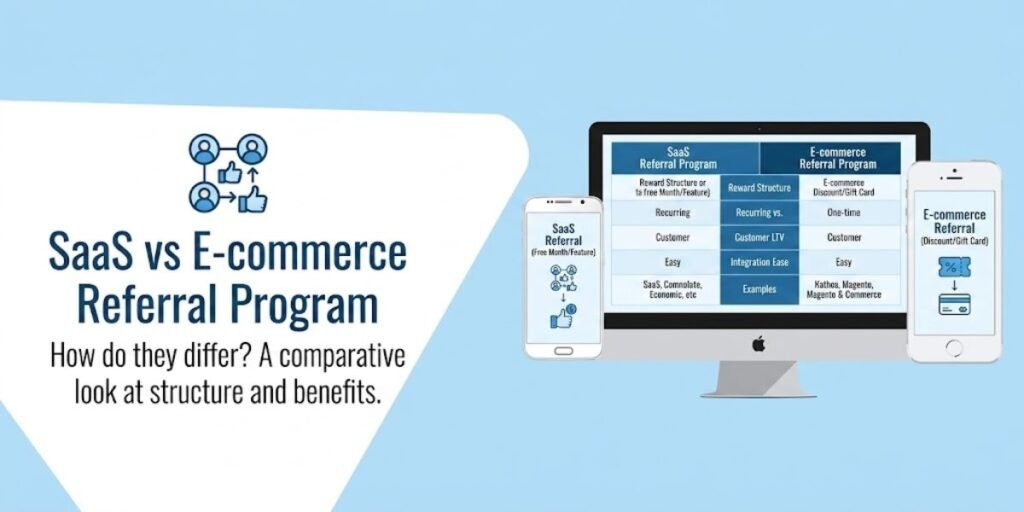
The referral widget on a checkout page and the one inside a SaaS dashboard can look almost identical. A customer shares a link, a friend signs up or buys, and the advocate gets a reward. Same three steps, same familiar mechanic. What sits underneath those steps could not be more different, and that difference is where most referral programs quietly succeed or lose money.
When a Shopify store rewards a referral, it is paying against a single order that clears in the next few minutes. When a subscription company rewards one, it is paying against a revenue stream that may run for years through renewals, seat expansions, and plan upgrades. A referred customer worth $100 today and a referred customer worth $100 a month are not the same acquisition, and treating them the same way is the fastest route to a program that either underpays advocates or bleeds margin. Everything downstream, from how you attribute the sale to when you release the reward to how you catch fraud, follows from that one structural fact.
A referral is worth whatever the business model makes it worth
The temptation is to judge a referral program by how many new customers it produces. That number tells you almost nothing on its own. A campaign can generate thousands of signups and still lose money on every one.
There is strong evidence that referred customers are genuinely better customers, regardless of industry. The cleanest data is academic rather than vendor-supplied. Philipp Schmitt, Bernd Skiera, and Christophe Van den Bulte of the Wharton School published a study in the Journal of Marketing that tracked roughly 10,000 customers of a German bank for almost three years. Referred customers carried a lifetime value at least 16 to 25 percent higher than matched non-referred customers, churned about 18 percent slower, and returned roughly 60 percent on the modest 25 euro referral fee over six years. That is the number worth anchoring to, because it is peer-reviewed and matched against a control group, and most of the louder vendor statistics ultimately trace back to it.
So referrals are worth pursuing. The question is what to pay for one, and that answer splits along the revenue model. Subscription revenue compounds: activation leads to a first paid month, which leads to renewals and expansion. Retail revenue is discrete: a purchase closes, and the next one has to be earned again. A recurring account credit handed to a high-retention SaaS subscriber can pay for itself many times over. That same generosity handed to a thin-margin retail buyer who never comes back destroys unit economics on contact. The reward is not the strategy. The revenue model is.
The customer journey decides what counts as a real referral
Before you can reward a referral, you have to define one, and the two models define it at completely different moments.
A SaaS buyer clicks a link, creates an account, spends time inside a trial or a demo, activates the product in some meaningful way, converts to a paid plan, and only much later renews or expands. A retail buyer lands on a storefront, adds an item to a cart, checks out, receives the package, and maybe reorders. Those are different shapes, and the shape dictates where success lives.
For e-commerce, success is close to the click. A referred order that clears checkout and survives the return window is, for practical purposes, done. For SaaS data, a free trial signup is worth almost nothing, because most trials never activate and most activations still have to convert. Marking a referral successful the moment someone opens a trial account is how programs end up paying real money for accounts that produce zero revenue. Success has to sit at activation or at the first paid invoice, not at signup. B2B SaaS programs typically see 10 to 20 percent of referred visitors start a trial and only 25 to 40 percent of those trials convert to paid, so the gap between signed up and worth paying for is enormous.
Match the reward to the margin
Reward menus look similar until you price them. SaaS programs lean on account credits, subscription discounts, usage credits, extended trials, plan upgrades, cash payouts, or affiliate-style commissions. E-commerce leans on percentage discounts, fixed-dollar credits, store vouchers, free shipping, product bundles, and loyalty points.
Dropbox is still the reference case for getting this right, and the reason is subtle. When it launched its two-sided program in 2008, both the referrer and the new user received 500MB of free storage per referral, capped at 16GB on the free plan. Signups went from 100,000 to four million in fifteen months, a 3,900 percent increase, with referrals driving roughly a third of daily signups at the peak. The mechanic worked because the reward was more of the product itself. Storage was the single most requested feature, so the incentive deepened engagement instead of just buying a transaction, and it cost Dropbox almost nothing to fulfill on Amazon S3. Compare that to the paid channels Dropbox had tested first, where Google AdWords produced a cost per acquisition of $233 to $388 on a product that sold for $99 a year. The referral program was not a nice-to-have. It was the only acquisition math that closed.
Retail cannot borrow that logic, because every discount is a direct hit to gross margin. This is why serious e-commerce programs gate their rewards. Brooklinen gives the referred friend $25 off, but only on a first order of $100 or more, and pays the referrer in loyalty points rather than cash. Allbirds offers a $15 credit on both sides, again tied to a $100 minimum. The minimum purchase is not a detail. It is the mechanism that protects contribution margin and filters for buyers who intend to spend, rather than bargain hunters who would have walked. A flat 20 percent discount with no floor looks generous and often loses money once you subtract cost of goods, shipping, returns, and the share of buyers who would have paid full price anyway. The only honest way to set a retail referral reward is to run the contribution margin math first and design the offer around what survives it.
The recurring-versus-one-time choice falls out of the same logic. E-commerce rewards are naturally one-time, because each purchase is a standalone event. SaaS can pay recurring commissions for as long as the referred account stays active, which sounds appealing and often is not. Recurring payouts inflate acquisition cost over a multi-year horizon, create standing liabilities against cash flow, complicate revenue recognition, and hand fraudsters an ongoing reason to game the system. For most software companies, a one-time credit tied to the first paid conversion produces cleaner economics than a commission that never ends.
Attribution and payout timing, where the money actually leaks
These two problems cause more quiet losses than reward design ever does.
Attribution is easy for retail and hard for software. A shopper clicks a link or enters a code and buys, and the system records it in one step. A SaaS prospect clicks a referral link, opens a trial, disappears for three weeks, comes back through an organic search, and converts. Deciding whether the referral gets credit for that sale is a genuine modeling problem involving first-touch versus last-touch rules, cookie windows, and cross-device identity. Getting it wrong is not just an accounting nuisance. When a real advocate’s referral goes uncredited because the buyer switched devices, that advocate stops referring, and losing your best advocates is far more expensive than any single missed reward.
Timing is where fraud gets in. Pay too early, at trial signup or account creation, and you invite fake accounts, disposable email addresses, and self-referrals farmed for credit. The fix is to release rewards against a milestone that correlates with real revenue. SaaS programs commonly wait for activation, for the conversion from trial to paid, for a 30-day retention window, or for a second billing cycle to clear. E-commerce ties payout to fulfillment, confirmed payment, and the expiry of the return window, so a referral bonus does not vest on an order that gets sent back a week later. Staggering the payout to match when the business actually recognizes the revenue is the single most effective fraud control most programs have, and it costs nothing to implement.
Retention is why referrals compound harder for SaaS
The Wharton team’s follow-up work, published in the Journal of Marketing Research, explained why referred customers behave better. Two mechanisms do the work: better matching, because a friend who knows both you and the product sends people who actually fit, and social enrichment, because the ongoing presence of the referrer improves the relationship. That second mechanism carries a warning that most write-ups skip. Referred customers churned more slowly only for as long as their referrer stayed. When the referrer left, the retention advantage faded.
For SaaS, that is close to a strategic thesis. Referred users tend to activate faster and stick longer because they arrive on trust, and in a subscription model longer retention compounds directly into revenue. But the effect is conditional, not automatic. The mistake is to assume referred cohorts retain better and stop measuring. They should be tracked as their own cohort against paid and organic acquisition, and the retention premium should be verified rather than believed. For e-commerce, the equivalent signals are second-purchase timing, reorder frequency, and category expansion. When referred buyers reorder faster and spend more per visit than the baseline, the program has crossed over from a discount line item into an actual growth channel.
Different plumbing
The integration surface is not the same, and choosing the wrong tooling creates manual work forever. A SaaS referral system has to talk to the subscription billing engine, the payment gateway, the CRM, and the product analytics stack, because the reward depends on knowing whether an account crossed from trial into paid. An e-commerce system integrates with the storefront platform, Shopify, WooCommerce, or Magento, and hooks into checkout, the loyalty ledger, and the automated discount-code engine. The right stack lets the qualifying event, whether that is a paid conversion or a shipped order, trigger the reward without an engineer in the loop.
Fraud wears different masks
Every program with money on the table attracts people trying to extract it. The masks differ. In SaaS, the common vectors are fake accounts, self-referrals through secondary email aliases, trial abuse, duplicate profiles, and stolen or throwaway payment methods used to clear the initial charge. In e-commerce, it is coupon codes leaking onto aggregator sites, self-referral across a shared household, mass account creation to harvest first-order discounts, and return abuse, where the referred order is placed, the credit is collected, and the item goes back. The countermeasures overlap: device fingerprinting, IP checks, automated fraud scoring, minimum order thresholds, and the delayed vesting already described, which invalidates a bonus if the underlying transaction turns out to be fake.
Measure what the model actually rewards
Reporting should mirror the economics, not flatter them. For SaaS businesses, total referral signups is a vanity metric if those trials never convert. The numbers that matter are trial-to-paid conversion, referral CAC, recurring revenue sourced from referrals, referred-cohort lifetime value, and net revenue retention. For e-commerce, the useful indicators are referred-order conversion rate, average order value relative to non-referred buyers, gross margin after the discount, repeat purchase rate, and blended program ROI. A dashboard full of high participation numbers means nothing if none of it reaches the bottom line, and referral CAC that runs 30 to 60 percent below paid search, which is a realistic target when the program is designed well, is worth far more than a big signup count.
Fit the ask to the relationship, and know where your model wins
The best referral prompts feel like part of the product, not a bolt-on. SaaS platforms should ask at moments of proven value: after an onboarding milestone, when a user invites collaborators into a workspace, or when a workflow objective is hit. E-commerce brands should ask right after delivery, inside the shipping-tracking email, or as a rung in an existing loyalty program. In both cases, timing the request to peak satisfaction does more for participation than raising the reward.
It also helps to know where your model has a structural edge, because that is where the program pays off fastest. SaaS referral programs run hottest when the product has built-in collaboration loops, high lifetime value, and professional network effects, the reasons Dropbox, Slack, and similar tools spread the way they did. E-commerce programs run hottest when the product is visually shareable, frequently reordered, backed by healthy margins, and supported by a real brand community. Copying a competitor’s mechanic without checking whether your model shares those traits is how programs end up misfiring.
A build sequence that works for either model
- Start by pinning down what one referred customer is actually worth across their full lifecycle.
- Set the margin or CAC ceiling you can spend against that number.
- Identify the point of highest satisfaction in the journey and put the ask there.
- Define the exact qualifying event that unlocks a reward, whether that is a paid conversion or a shipped-and-kept order.
- Choose an incentive the margins can carry.
- Set the attribution window and tracking method.
- Decide when the reward vests so fraud and refunds are priced out.
- Wire the fraud controls in from the start.
- Connect the tracking directly to billing or checkout so qualification is automatic.
- Measure incremental revenue and cohort retention, and keep adjusting the incentive against what the data shows.
Quick comparison
| Factor | SaaS | E-commerce |
| Revenue model | Recurring subscription | Transaction-based retail |
| Referral value | Compounds through retention and expansion | Tied to order size and repeat rate |
| Conversion path | Signup, trial, activation, paid | Visit, cart, checkout |
| Typical rewards | Account credits, plan discounts, usage credits, cash | Percentage or dollar discounts, store credit, loyalty points |
| Reward timing | After activation, paid conversion, or a retention window | After fulfillment and the return window |
| Core economics | LTV, churn, MRR/ARR, CAC payback | AOV, gross margin, repeat rate |
| Hardest tracking problem | Multi-touch attribution over long trials | Coupon leakage and cross-device checkout |
| Common fraud | Fake accounts, disposable trials, self-referral | Coupon stacking, return abuse, self-referral |
Frequently asked questions
Are SaaS and e-commerce referral programs really different?
The word-of-mouth idea is the same, but the economics are not. Subscription revenue, activation hurdles, and multi-week evaluation journeys make SaaS programs behave differently from transaction-based retail rewards, and the reward design, payout timing, and metrics all diverge as a result.
Should SaaS referral rewards be recurring?
Usually not. Recurring commissions suit affiliate-heavy models, but a one-time credit tied to the first paid conversion tends to produce more predictable economics once you account for churn and multi-year payout liabilities.
What is a good referral reward for an e-commerce brand?
There is no fixed figure. Set it from gross margin, average order value, and repeat-purchase probability, and consider a minimum order threshold, the way Brooklinen and Allbirds gate their offers at $100, to protect margin and filter for real buyers.
When should a SaaS referral reward be paid?
After a milestone that correlates with revenue, typically the trial-to-paid conversion or the clearing of an initial retention window, so fake trial signups never generate a payout.
How do you measure referral program ROI?
Compare incremental revenue and referred-cohort lifetime value against total reward cost, platform fees, and management overhead, and benchmark referred customers against paid search and social to confirm the channel is genuinely more efficient.