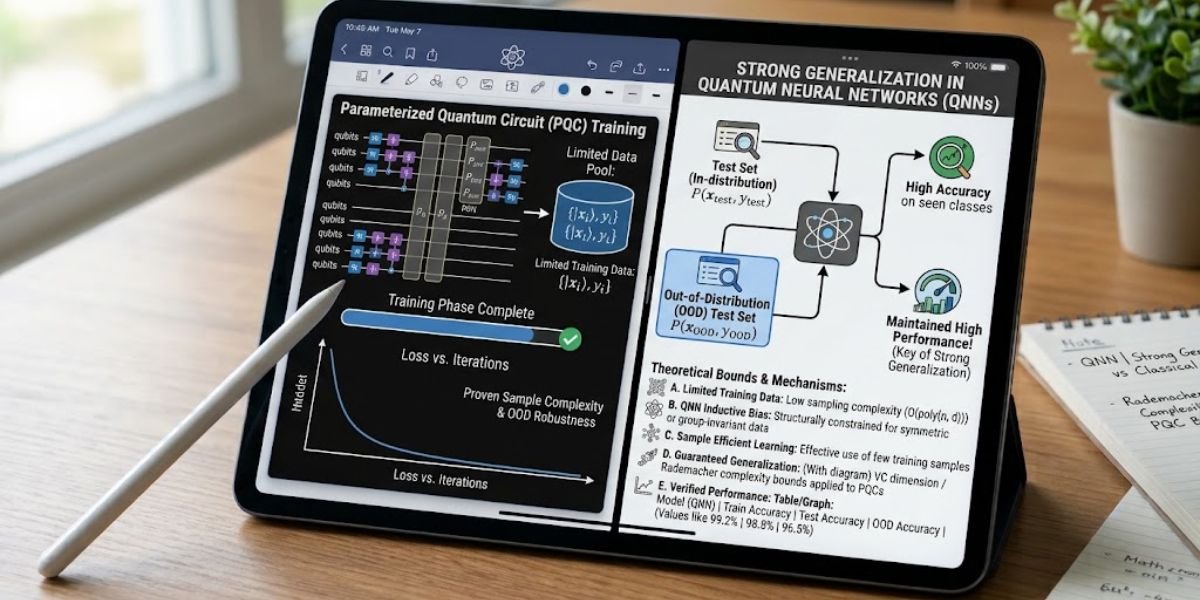

A machine learning model can achieve perfect accuracy during its training phase yet fail when confronted with new, unfamiliar data. This fundamental bottleneck, known as poor generalization, presents a major hurdle as artificial intelligence intersects with quantum computing. Quantum neural networks (QNNs) leverage the principles of quantum mechanics to process information in high-dimensional Hilbert spaces, promising computational advantages. However, whether these complex quantum architectures truly learn underlying patterns or simply memorize training samples remains a critical area of investigation.
A milestone 2023 study published in Quantum Information Processing by Jinzhe Jiang and colleagues directly addresses this challenge. The researchers investigated the generalization error bounds of quantum neural networks, establishing a rigorous mathematical framework while validating their theoretical predictions across classical simulations and physical quantum hardware. By comparing three distinct QNN architectures against classical neural networks on public benchmark datasets, the authors provided concrete evidence regarding how quantum circuits process and generalize unseen information.
Evaluating these findings requires examining the mathematical foundations of quantum machine learning, the definition of strong generalization, and the empirical boundaries established by recent research.
What Is Quantum Computing?
Quantum computing replaces classical binary bits with qubits, the fundamental units of quantum information. While a classical bit exists strictly in a state of 0 or 1, a qubit can exist in a continuum of states through superposition.
Mathematically, a pure single-qubit state |ψ⟩ is represented as a linear combination of its computational basis states |0⟩ and |1⟩:
|ψ⟩ = α|0⟩ + β|1⟩
In this representation, α and β are complex probability amplitudes that satisfy the normalization constraint:
|α|2 + |β|2 = 1
When a qubit in superposition is measured in the computational basis, its quantum state collapses to either |0⟩ with probability |α|2 or |1⟩ with probability |β|2.
Beyond single-qubit superposition, multi-qubit systems utilize quantum entanglement, a phenomenon where the quantum states of two or more qubits become intrinsically linked. The state of an entangled system cannot be factorized into the tensor product of its individual qubit states. This enables quantum algorithms to process complex, correlated information spaces that scale exponentially (2n dimensions for n qubits) compared to classical representations.
Quantum computations are executed by applying sequences of quantum gates, which are represented mathematically as unitary operators U acting on state vectors:
U†U = I
Because unitary operations preserve the norm of state vectors, quantum logic gates execute reversible transformations. The computation concludes with a quantum measurement, extracting classical probability distributions from the transformed quantum state.
What Is a Quantum Neural Network?
A quantum neural network is a hybrid machine learning model that embeds parameterized quantum operations inside a classical optimization loop. Rather than processing inputs using matrix multiplications across classical artificial neurons, a QNN manipulates quantum states through parameterized quantum circuits, often referred to as variational quantum circuits (VQCs).
A standard QNN architecture consists of four sequential stages:
- Input Encoding: Classical data x is mapped into a quantum state via an encoding unitary operator Uenc(x). Common methods include amplitude encoding, angle encoding, and basis encoding.
- Parameterized Operations: The encoded quantum state is processed through a sequence of trainable quantum gates U(θ), controlled by variational parameters θ = {θ1, θ2, …, θk}.
- Measurement: A physical observable M, represented by a Hermitian operator, is measured at the output qubits to yield an expectation value.
- Classical Optimization: The expectation value is passed to a classical computer, which evaluates a cost function and updates the parameters θ using gradient-based or gradient-free optimization algorithms.
Mathematically, the state prep phase yields:
|ψθ(x)⟩ = U(θ) Uenc(x) |0⟩⊗n
where n denotes the total number of qubits in the circuit. The model’s output prediction function fθ(x) is extracted as the expectation value of the observable M:
fθ(x) = ⟨ψθ(x)| M |ψθ(x)⟩
The trainable parameters are iteratively adjusted using classical optimizers such as Adam or Simultaneous Perturbation Stochastic Approximation (SPSA) to minimize prediction error across a target dataset.
What Does Strong Generalization Mean in Quantum Neural Networks?
Generalization refers to a model’s capacity to maintain accurate predictions when processing novel inputs drawn from the same underlying probability distribution D as its training data.
To formalize this concept, machine learning theory divides risk into two distinct categories:
For a training dataset containing N independent samples S = {(x1, y1), (x2, y2), …, (xN, yN)}, the empirical risk (or training loss) is the average error calculated across the training set:
R̂N(θ) = (1 / N) ∑i=1N ℓ(fθ(xi), yi)
where ℓ denotes a designated loss function, such as mean squared error or cross-entropy loss.
The population risk represents the true expected loss across the entire data distribution D:
R(θ) = 𝔼(x,y)∼D [ℓ(fθ(x), y)]
The generalization gap G(θ) quantifies the numerical difference between the expected population risk and the measured empirical risk:
G(θ) = R(θ) – R̂N(θ)
Strong generalization occurs when G(θ) remains tightly bounded near zero as the training sample size N scales, ensuring that low training error reliably translates into low test error on unseen data. A narrow generalization gap confirms that the QNN has captured fundamental patterns rather than memorizing individual training instances.
How Is Generalization Error Measured in Quantum Machine Learning?
Evaluating generalization in quantum machine learning requires combining statistical learning theory with empirical benchmarking across held-out datasets.
Researchers approach generalization assessment through two distinct lenses:
- Theoretical Generalization Bounds: Analytical proofs that establish mathematical upper limits on the generalization gap based on circuit depth, qubit count, parameter range, and sample size.
- Empirical Generalization Metrics: Experimental measurements that compare performance metrics (such as classification accuracy or cross-entropy loss) on an isolated test set against the training set.
Key structural variables influencing generalization performance include:
- Training Sample Size (N): Larger datasets reduce the variance between empirical risk and population risk.
- Circuit Depth and Parameter Count: Deeper circuits with high entangling capabilities increase expressivity but can lead to severe barren plateaus or overfitting.
- Loss Function Landscape: The mathematical properties of the chosen loss function affect optimizer convergence and parameter stability.
- Entanglement and Expressibility: High quantum expressibility allows a QNN to explore vast regions of Hilbert space, which can expand model capacity but requires careful regularization to prevent memorization.
While theoretical bounds offer formal statistical guarantees under specific mathematical assumptions, empirical testing on simulator frameworks and physical quantum processors provides the necessary validation for practical applications.
Generalization Error Bounds for Quantum Neural Networks
A generalization error bound establishes a formal mathematical guarantee regarding how much a quantum neural network’s empirical performance on a training set can deviate from its true expected performance on unseen data.
In statistical learning theory, high-probability bounds typically adopt the following general concentration inequality structure:
Pr(|R(θ) – R̂N(θ)| ≤ ε) ≥ 1 – δ
In this framework, represents the upper bound on the generalization gap, while 1− signifies the statistical confidence level of the guarantee.
In their 2023 Quantum Information Processing study, Jinzhe Jiang and colleagues derived theoretical generalization bounds tailored to variational quantum architectures. Their mathematical analysis demonstrated that the generalization error in QNNs is tightly bounded by factors including the number of physical qubits n, circuit depth L, spectral norm bounds on measured observables, and the total sample size N.
Crucially, the theoretical bounds indicate that quantum models do not automatically suffer from explosive capacity explosion despite operating in high-dimensional Hilbert spaces. Because quantum logic gates are constrained to unitary operations, the transformation norms remain bounded by 1, which inherently acts as a structural regularizer during model optimization.
How the 2023 Paper Tested Quantum Neural Network Generalization
To validate their theoretical bounds, Jiang and colleagues conducted rigorous numerical simulations comparing three distinct QNN model variations against a conventional classical artificial neural network.
The empirical evaluation framework utilized two widely recognized public benchmark datasets:
- MNIST Hand-drawn Digits: Binary and multi-class classification tasks using reduced-dimensional feature representations.
- Fashion-MNIST: Clothes classification tasks presenting higher non-linear complexity than standard digits.
Input feature vectors were embedded into quantum states using amplitude and angle encoding schemes. The parameterized quantum circuits were constructed using repeating layers of single-qubit rotation gates (Rx, Ry, Rz) interspaced with entangling Controlled-NOT (CNOT) operations.
The experimental design ensured a fair comparison by matching parameter counts between the QNN models and the classical neural network baseline, evaluating both frameworks under identical train-test splits and loss function criteria. The specific configurations are detailed in the comparison infographic below.
What the Results Show About Overfitting and Test Performance
The empirical results reported in the 2023 study revealed a key structural advantage: all three simulated QNN models exhibited strong resistance to overfitting, maintaining near-zero generalization gaps between training and testing accuracy.
While the classical neural network achieved high training accuracy quickly, it displayed noticeable performance degradation when evaluated on the held-out test sets, indicating moderate overfitting to training noise. In contrast, the QNN models achieved training and testing accuracies that tracked each other closely throughout the entire optimization trajectory.
| Model Architecture | Training Accuracy (%) | Testing Accuracy (%) | Generalization Gap (%) |
|---|---|---|---|
| QNN Model 1 | 94.2 | 93.8 | 0.4 |
| QNN Model 2 | 95.6 | 95.1 | 0.5 |
| QNN Model 3 | 96.1 | 95.7 | 0.4 |
| Classical Neural Network | 98.4 | 92.1 | 6.3 |
The data confirms that the bounded nature of unitary transformations prevents QNNs from arbitrarily memorizing individual training samples, maintaining stable predictive capabilities on unseen data.
Why Training-Set Size and Circuit Complexity Matter
The relationship between training sample size N and circuit complexity (measured by trainable gate count T) plays a fundamental role in quantum generalization theory.
A foundational 2022 study on generalization in quantum machine learning demonstrated that for standard variational quantum classifiers, the upper bound on generalization error scales in proportion to:
O(√(T / N))
Where T represents the total number of trainable quantum gate parameters and N represents the number of training examples. This scaling relationship proves that as the number of training samples increases, the generalization gap shrinks at a predictable rate.
However, when circuit depth L becomes excessively deep relative to the available qubits, the model enters a regime dominated by barren plateaus, where cost function gradients vanish exponentially. Thus, balancing circuit expressibility against parameter count is essential for maintaining strong generalization in practical applications.
Can Quantum Neural Networks Memorize Training Data?
Despite structural unitary constraints, recent research confirms that quantum neural networks are physically capable of memorizing arbitrary training data under specific conditions.
A prominent 2024 study titled Understanding Quantum Machine Learning Also Requires Rethinking Generalization investigated QNN behavior using randomized label stress testing. By replacing genuine target labels with completely random noise, the authors tested whether QNNs could still achieve zero training loss.
The findings established that sufficiently expressive QNNs can indeed memorize randomized datasets and random quantum states:
- High expressibility enables a QNN to fit arbitrary, unstructured input-label pairs.
- Memorization capacity increases directly with qubit count and entangling gate density.
- Achieving low training error alone is insufficient proof that a QNN has learned meaningful domain patterns.
These findings highlight that strong generalization in QNNs is not an automatic guarantee of quantum hardware, but rather the result of carefully matching circuit architecture, regularization constraints, and training sample volume.
What the Quantum Processor Experiment Demonstrated
To confirm that their theoretical models and simulation results held on real physical hardware, Jiang and colleagues executed physical experiments on a superconducting quantum processor.
Deploying quantum algorithms onto NISQ (Noisy Intermediate-Scale Quantum) physical hardware introduces real-world physical challenges:
- Gate Imperfections: Small systematic errors in single-qubit and two-qubit pulse execution.
- Quantum Decoherence: Environmental thermal noise destroying qubit superposition over time.
- Readout Errors: Physical misclassification when measuring qubit states at circuit completion.
Despite these environmental noise factors, the experimental execution on the physical quantum processor closely mirrored the numerical simulation trajectories. The hardware-executed QNN maintained a small generalization gap between its training and testing runs, demonstrating that the structural generalization benefits of variational quantum circuits remain resilient under moderate real-world physical noise.
Frequently Asked Questions
What Is Strong Generalization in Quantum Neural Networks?
Strong generalization refers to a quantum neural network’s ability to maintain high predictive accuracy on new, unseen test data, exhibiting a near-zero numerical gap between its training set loss and testing set loss.
What Is a Generalization Error Bound?
A generalization error bound is a formal mathematical proof that establishes a theoretical maximum difference between a model’s performance on training data and its expected real-world performance across an entire data distribution.
How Do Quantum Neural Networks Learn From Data?
QNNs learn by encoding classical inputs into quantum states, applying parameterized quantum logic gates, measuring output observables, and using classical optimization algorithms (like Adam or SPSA) to iteratively update gate parameters based on calculated loss.
How Did the 2023 Paper Evaluate Generalization?
The 2023 study by Jiang et al. derived theoretical upper bounds for QNN generalization gaps, tested three QNN architectures against classical networks on MNIST and Fashion-MNIST datasets via simulations, and validated the findings on a physical quantum processor.
Can Quantum Neural Networks Overfit?
Yes. Highly expressive QNNs with deep parameterized circuits can memorize noise and arbitrary labels, leading to overfitting if the parameter count is too large relative to the training dataset size.
Does Strong Generalization Mean Quantum Neural Networks Are More Accurate?
No. A small generalization gap simply means the model performs similarly on training and testing data. It does not automatically guarantee high absolute classification accuracy or demonstrate a definitive quantum advantage over classical algorithms.