An enterprise security gateway deployed at the network edge performs multiple critical functions simultaneously. It must control traffic flows, enforce granular security policies, interconnect disparate sites, inspect active applications, terminate secure virtual private networks, and detect emerging threats while maintaining predictable, high-speed network performance.
The Juniper SRX1500-AC is a high-performance next-generation firewall and security platform built to meet these demanding operational requirements.
Juniper integrates core firewalling, advanced carrier-class routing, VPN termination, application visibility, and intrusion prevention capabilities directly into a single 1U hardware platform.
Evaluating this device raises a central question for network architects: What does the SRX1500-AC actually bring to an enterprise network, and why would an organization deploy it instead of relying on a basic perimeter firewall?
What Is the Juniper SRX1500-AC?
The SRX1500 sits within Juniper’s proven SRX family, engineered specifically as a next-generation firewall and security services gateway.
The AC designation indicates that the appliance operates using alternating current power supplies. This specific model incorporates a 120 GB solid-state drive, providing roughly 100 GB of usable local storage space for logs, system images, and security intelligence packages.
Current technical documentation from Juniper positions the SRX1500 for distributed enterprise campuses, regional headquarters, large branch offices, and small to medium-sized data centers.
Running on the robust Junos OS, the device unifies high-speed packet processing with deep software capabilities, serving as an architectural anchor for organizations scaling their perimeter defense.
Juniper SRX1500-AC Specifications
| Specification | SRX1500-AC Appliance Value |
| Form factor | 1U rack-mountable chassis |
| 1GbE Copper Ethernet | 12 ports |
| 1GbE SFP Optical | 4 ports |
| 10GbE SFP+ Optical | 4 ports |
| PIM slots | 2 expansion slots |
| Storage (SSD) | 120 GB total, 100 GB usable space |
| Power configuration | AC power with dual power-supply slots |
| Firewall performance | Up to 9.2 Gbps current listed maximum |
| IPS performance | Up to 3.3 Gbps |
| VPN performance | Up to 4.5 Gbps |
| Concurrent sessions | Up to 2 million sessions |
| Operating system | Junos OS |
The SRX1500-AC Hardware and Network Interfaces
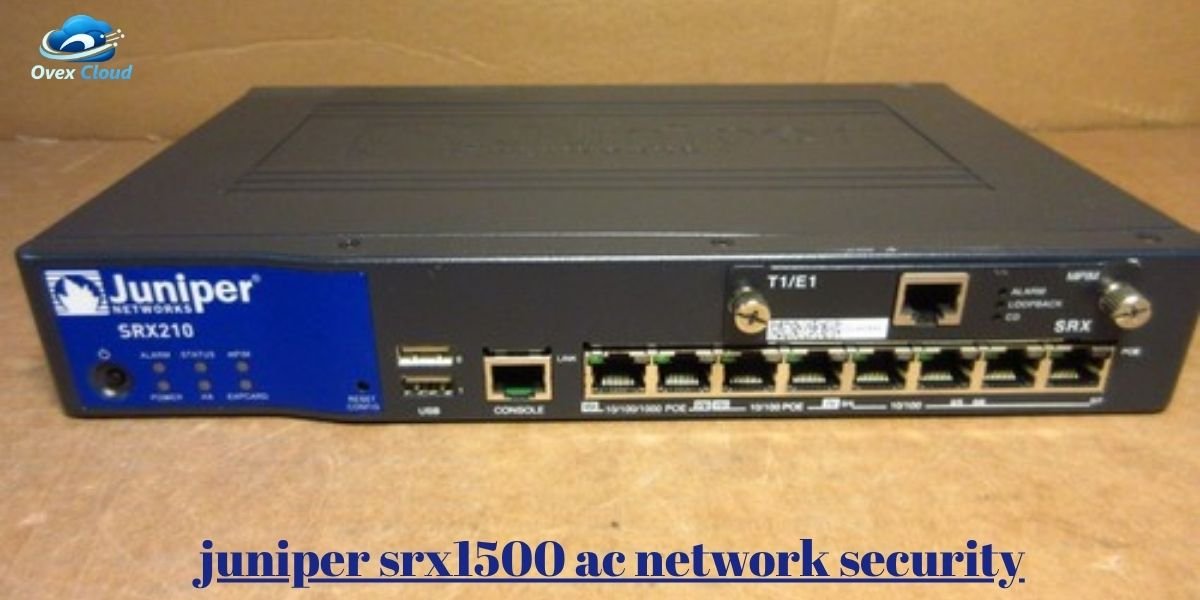
The hardware layout of the SRX1500 is engineered for physical network flexibility at the edge. The 1U chassis features 12 copper 1GbE ports, four 1GbE optical SFP ports, and four high-speed 10GbE SFP+ ports.
This hybrid mix of interfaces allows network engineers to connect legacy switching equipment alongside modern high-speed backbone links without requiring immediate external media converters. The 10GbE SFP+ interfaces handle dense traffic aggregation from core campus switches or data center racks efficiently.
Additionally, the appliance includes two physical Interface Module slots to support WAN expansion options and dual power supply slots for electrical redundancy. Viewing the hardware layout as an architectural foundation highlights how the device accommodates diverse physical topologies.
Firewall Services and Traffic Control
As an enterprise-grade security gateway, the SRX1500 executes comprehensive packet processing via dedicated hardware acceleration chips.
- Stateful and stateless firewall inspection
- Zone-based security policies
- Network Address Translation (NAT) including source, destination, and static variants
- Distributed Denial of Service (DDoS) protection and screen options
- Protocol and traffic anomaly protection
- SSL/TLS inspection for encrypted traffic visibility
These services operate in a synchronized pipeline. Security policies dictate whether a packet is permitted across administrative zones, while underlying screening engines inspect allowed flows for anomalous headers, malformed payloads, or volumetric flood signatures.
Application Visibility and Control
Traditional port-based firewalls struggle to identify modern web applications that dynamically shift ports or mimic standard HTTP/HTTPS traffic.
The SRX1500 incorporates advanced AppID and AppSecure technologies, capable of identifying thousands of Layer 3 through Layer 7 applications, including encrypted Web 2.0 protocols.
Administrators can construct policies based on specific application names or groups rather than relying solely on IP addresses and TCP/UDP ports.
This granular capability allows network teams to prioritize business-critical SaaS tools, throttle unauthorized recreational streaming, or restrict risky shadow IT applications across the campus network.
Intrusion Prevention and Advanced Threat Protection
Enforcing perimeter rules represents only the first line of defense; active inspection determines whether permitted traffic carries malicious payloads.
The SRX1500 integrates a high-performance Intrusion Prevention System (IPS), alongside signature databases for antivirus, anti-spam, and web filtering.
By deploying Juniper ATP Cloud, the gateway offloads suspicious files and zero-day samples to cloud-based sandboxing engines for behavioral analysis.
This multi-layered architecture ensures that known exploit patterns are blocked locally at wire speed while novel, complex threats are isolated before reaching internal hosts.
VPN and Secure Connectivity
Enterprise networks require robust encryption to interconnect remote sites, mobile workers, and cloud environments securely.
The SRX1500 acts as a high-capacity IPsec VPN hub, supporting site-to-site tunnels, hub-and-spoke models, automated Auto-VPN configurations, and Group VPN deployments.
For remote workforce access, the gateway integrates with Juniper Secure Connect to deliver flexible SSL VPN tunnels.
Embedding these capabilities into the security gateway consolidates encryption processing onto dedicated internal crypto engines, preventing routing bottlenecks during heavy remote-access loads.
Performance and Capacity
Raw throughput numbers provide a baseline for hardware capability, but real-world behavior depends heavily on active feature sets.
The SRX1500 delivers up to 9.2 Gbps of maximum firewall throughput, 3.3 Gbps of IPS performance, and 4.5 Gbps of IPsec VPN capacity.
Evaluating the hardware using IMIX traffic profiles or enabling heavy SSL inspection and deep IPS signatures will naturally alter total packet processing limits.
Network planners must size the appliance against anticipated concurrent sessions, which scale up to 2 million active states, ensuring the gateway avoids congestion during traffic spikes.
High Availability and Redundant Power
Edge security gateways serve as single points of failure unless deployed within resilient, fault-tolerant architectures.
The SRX1500 supports robust chassis clustering, enabling two identical appliances to operate in active/active or active/backup operational states.
Clustering synchronizes firewall session states, security association databases, and dynamic routing tables in real time, ensuring seamless session failover if a primary hardware node experiences an outage.
At the component level, the appliance features dual power supply slots, allowing organizations to install redundant, hot-swappable AC power modules connected to independent utility feeds to protect against electrical failures.
Junos OS and Management
Operational efficiency depends heavily on the administrative ecosystem powering the security gateway.
The SRX1500 runs on Junos OS, providing a modular, single-source operating system shared across Juniper’s routing, switching, and security portfolios.
Network administrators can configure and monitor the appliance using the industry-standard Command Line Interface (CLI), the built-in J-Web graphical interface, or centralized multi-device management platforms.
This architectural consistency reduces administrative overhead, simplifies policy auditing, and allows security teams to apply unified automation scripts and telemetry tools across the entire enterprise fabric.
Deployment and Provisioning
Scaling security infrastructure across distributed enterprise sites introduces logistical challenges that manual configuration cannot easily solve.
The SRX1500 supports Zero Touch Provisioning (ZTP), allowing newly deployed hardware to bootstrap its configuration, download security packages, and establish secure management tunnels automatically upon physical power-up.
This automation capability drastically reduces staging time for regional headquarters and large branch deployments.
Network teams can ship unconfigured hardware directly to remote sites, relying on pre-defined templates pushed from centralized management controllers to bring security perimeters online securely and consistently.
Where the SRX1500-AC Fits in an Enterprise Network
Placing the SRX1500 effectively requires aligning its hardware throughput and feature set with specific architectural boundaries.
- Enterprise campuses: Positioned as the primary security perimeter between internal user subnets and external WAN connections, enforcing strict zone-based policies.
- Regional headquarters: Acting as a consolidated hub for mid-sized offices requiring high-speed site-to-site VPN aggregation and local internet breakout inspection.
- Large branch environments: Handling dense local traffic while supporting modular WAN expansion through dedicated PIM slots.
- Small to medium-sized data centers: Securing north-south traffic boundaries and inspecting east-west workload interactions against unauthorized lateral movement.
What to Consider Before Deploying an SRX1500-AC
Selecting the SRX1500 for a production environment requires careful validation of capacity, physical constraints, and licensing requirements.
- Calculate expected peak traffic throughput against mixed-workload profiles rather than maximum stateless numbers.
- Verify whether resource-intensive services like deep IPS inspection, SSL decryption, and Advanced Threat Protection will be fully enabled.
- Confirm that the interface mix of twelve 1GbE copper ports, four 1GbE SFP slots, and four 10GbE SFP+ ports matches existing upstream and downstream switch connections.
- Ensure rack space accommodates a standard 1U chassis and that local electrical feeds support redundant AC power supplies.
- Review required Junos OS versions and feature licenses for advanced routing or security packages before final procurement.
Frequently Asked Questions
Is the Juniper SRX1500-AC a firewall?
Yes, it is an enterprise-grade next-generation firewall and security services gateway that combines stateful packet inspection, routing, and threat mitigation in a single platform.
What is the difference between SRX1500-AC and SRX1500-DC?
The primary difference lies in the power configuration, where the AC model utilizes alternating current power supplies, while the DC model is engineered for direct current data center environments.
How fast is the SRX1500 firewall?
The appliance delivers up to 9.2 Gbps of maximum firewall throughput, though real-world performance varies based on active security features, packet sizes, and traffic mixes like IMIX.
How many ports does the SRX1500-AC have?
The hardware features 12 copper 1GbE ports, four 1GbE SFP optical ports, and four 10GbE SFP+ high-speed optical ports, alongside two modular PIM expansion slots.
Does the SRX1500 support VPN?
Yes, it functions as a high-capacity IPsec VPN gateway supporting site-to-site tunnels, hub-and-spoke models, and remote-access connections via Juniper Secure Connect.
Does the SRX1500 support IPS?
Yes, it integrates a high-performance Intrusion Prevention System that inspects permitted traffic for malicious signatures and anomalous protocol behavior.
What operating system does the SRX1500 use?
It runs on Junos OS, providing consistent command-line structures, modular software processes, and advanced automation capabilities.
Where is the SRX1500 normally deployed?
It is typically deployed at the perimeter of enterprise campuses, regional headquarters, large branch offices, and smaller data center environments requiring robust edge security.