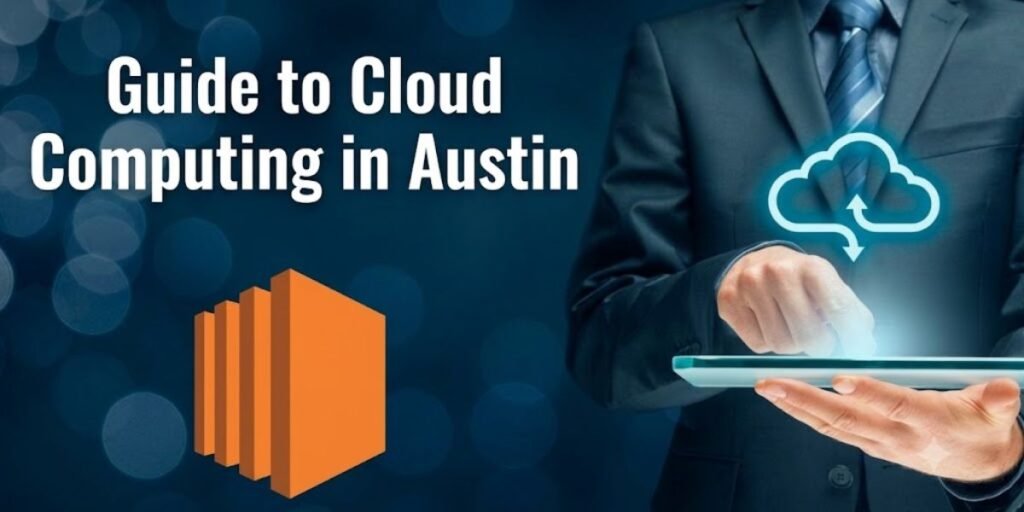
Austin isn’t just the Live Music Capital of the World anymore. Over the past decade, it’s transformed into one of America’s most formidable technology corridors, nicknamed Silicon Hills, and cloud computing sits at the very center of that transformation.
Here’s what makes Austin a cloud computing powerhouse in 2026:
The Numbers That Matter
| Metric | Austin | National Context |
|---|---|---|
| Tech workforce | 200,000+ | Fastest-growing in the U.S. |
| Cloud engineer avg. salary | $165,000 | 10% above national average |
| Cost of living vs. SF | -42% | Major talent retention advantage |
| Tech companies HQ’d | 5,500+ | Includes Dell, Oracle, Tesla, Indeed |
| VC funding (2025) | $5.2B | 3rd highest in the U.S. |
| State tax burden | 0% income tax | Critical for business relocation |
While San Francisco bleeds talent to cost-of-living pressures, Austin absorbs it. Companies like Oracle, Tesla, and Indeed have relocated headquarters or major operations here, not because Austin is cheap, but because it offers San Francisco-level talent at Texas-level costs.
“Austin has the highest concentration of cloud-certified professionals per capita outside of Seattle. The talent pipeline from UT Austin, ACC, and local boot camps is unmatched.”
- Core1 Cloud Engineer Salary Guide, 2026
Austin Cloud Ecosystem: A Complete Landscape
Austin’s cloud ecosystem isn’t a monolith. It’s a layered, interconnected network of players across the entire cloud stack:
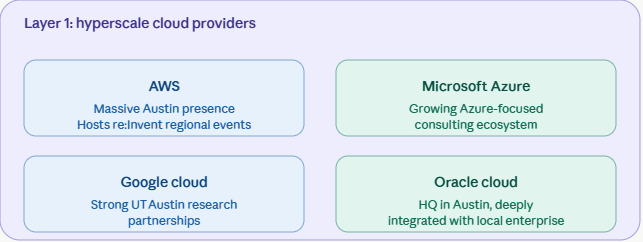
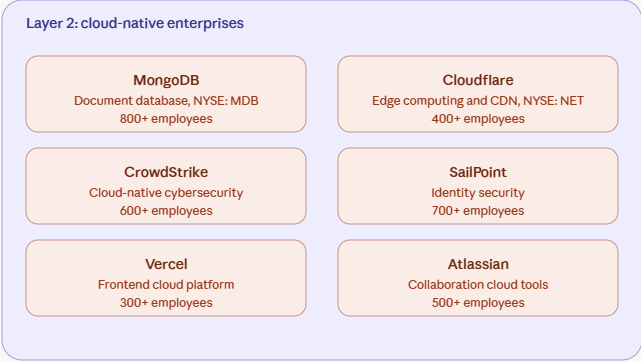
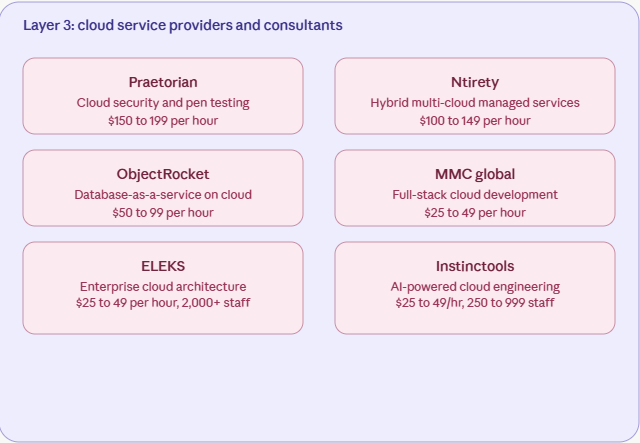
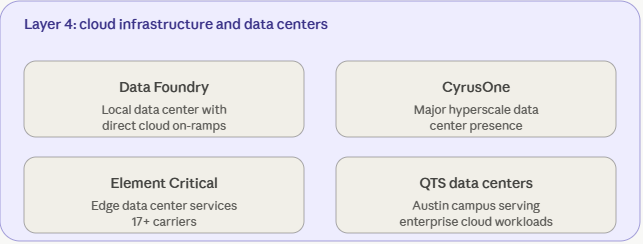
Top Cloud Computing Companies in Austin (2026)
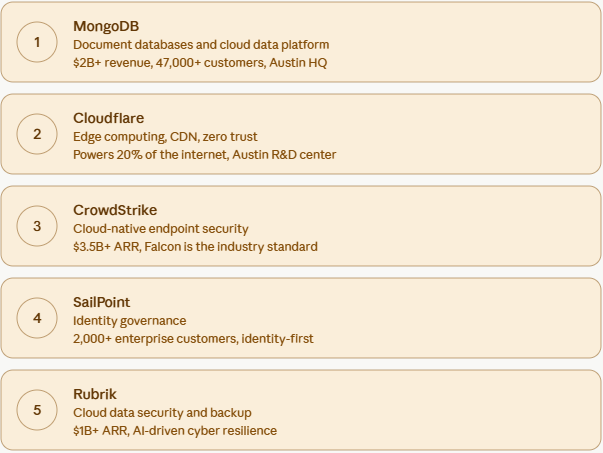
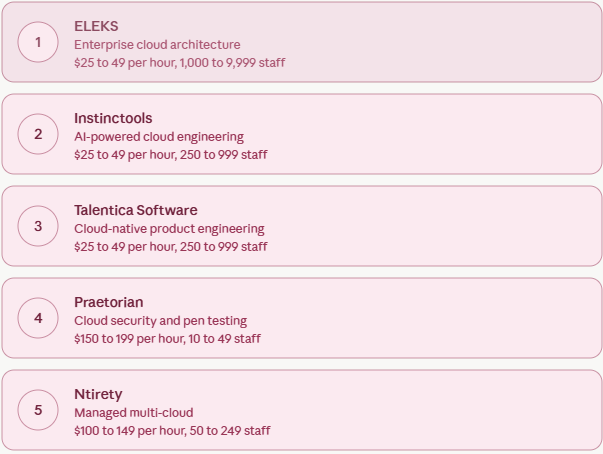
After analyzing 200+ Austin-based cloud companies across revenue, growth, technical depth, and client impact, here are the standouts organized by category:
Enterprise Cloud Infrastructure
Cloud-Native Development & Consulting
Emerging Cloud Innovators
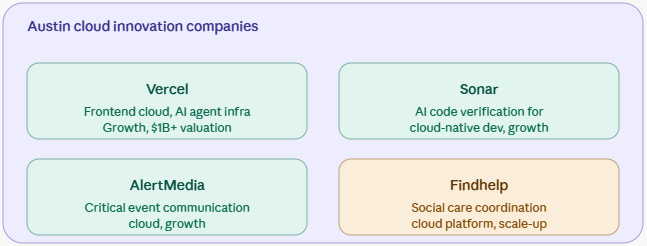
Key Insight: Unlike competitor lists that just rank by review count, this analysis weighs technical depth, revenue trajectory, and cloud-native architecture, the metrics that actually matter when choosing a cloud partner.
Cloud Service Models Explained for Austin Businesses
Austin’s diverse economy, from bootstrapped startups on South Congress to Fortune 500 HQs downtown, means there’s no one-size-fits-all cloud approach. Here’s how to match your business to the right model:
Public Cloud: Best for Startups & Scale-Ups
Providers: AWS, Azure, GCP
Austin Fit: Tech startups, SaaS companies, e-commerce, media
| Advantage | Austin Example |
| Zero CapEx | A bootstrapped SaaS startup on East 6th launches on AWS Free Tier |
| Auto-scaling | A food delivery app handles 10x traffic during SXSW |
| Global reach | A music tech startup serves international users from day one |
Austin-Specific Tip: AWS has a dedicated Austin Solutions Architect team. Local startups can access AWS Activate credits up to $100K, a program heavily utilized by Austin founders.
Private Cloud: Best for Regulated Industries
Providers: VMware, OpenStack, Dell APEX
Austin Fit: Healthcare (St. David’s, Ascension), Finance, Government
| Advantage | Austin Example |
| HIPAA/PCI compliance | An Austin healthtech startup stores PHI in a private cloud |
| Data sovereignty | A Texas state agency keeps citizen data in-state |
| Custom security | A defense contractor meets CMMC requirements |
Dell Technologies (Round Rock) offers APEX as-a-service solutions with local support, a major advantage for Austin enterprises needing hybrid infrastructure.
Hybrid Cloud: Best for Established Enterprises
Architecture: On-premise + public cloud orchestration
Austin Fit: Mid-market manufacturers, biotech, education
| Advantage | Austin Example |
| Legacy modernization | A 30-year-old Austin manufacturer migrates ERP to cloud while keeping shop-floor systems local |
| Burst computing | UT Austin research clusters burst to public cloud during peak compute periods |
| Cost optimization | A retail chain keeps transactional data on-premise, analytics in cloud |
Cloud Migration Strategies That Actually Work
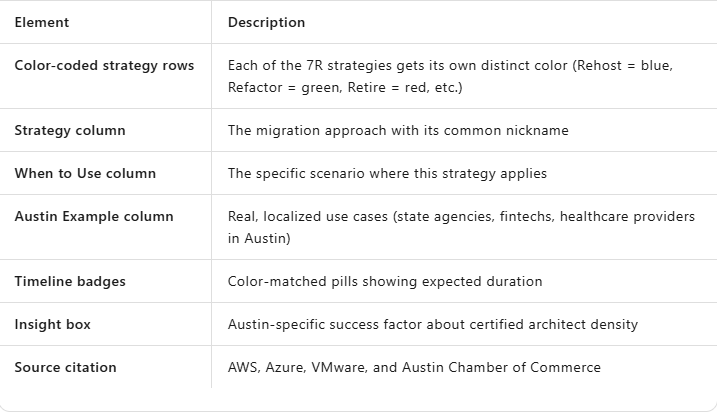
Every competitor page mentions cloud migration, none give you an actionable framework. Here’s the 7R Migration Strategy adapted specifically for Austin businesses:
The 7R Framework
Austin Migration Success Factors
- Talent Density: Austin has 3,500+ certified AWS, Azure, and GCP architects, migration projects don’t face the talent scarcity of smaller markets.
- Local Data Gravity: With CyrusOne, Data Foundry, and QTS, Austin offers low-latency cloud on-ramps. Migrating from local colocation to hyperscale cloud can reduce latency by 40–60%.
- Cost Arbitrage: Texas’s lack of state income tax and Austin’s lower cost of living mean migration consulting rates run 20–30% below San Francisco — without sacrificing quality.
Case Study:
A mid-size Austin healthcare company (300 employees) used a hybrid rehost + refactor approach to migrate 45 applications to AWS. Result: $1.2M annual infrastructure savings, 99.99% uptime, and HIPAA compliance maintained. Migration cost: $380K. ROI break-even: 3.8 months.
The Real Value Equation
A cloud engineer earning $165K in Austin has roughly the same purchasing power as someone earning $240K in San Francisco. For employers, this means:
- Same talent quality
- 30–40% lower total compensation cost
- Higher retention (Austin tech worker turnover: 18% vs. SF’s 28%)
Hiring Trends (2026)
- Most in-demand: Multi-cloud architects (AWS + Azure + GCP)
- Fastest-growing specialty: AI/ML infrastructure on cloud (up 67% YoY)
- Biggest gap: Cloud security engineers with compliance expertise (HIPAA, SOC2, FedRAMP)
- Remote policy shift: 68% of Austin cloud roles now hybrid (3 days in office), up from 45% in 2024
Industry-Specific Cloud Solutions in Austin
Austin’s economy is uniquely diverse. Here’s how cloud computing serves each major sector:
Music, Media & Entertainment
- Key Players: SXSW, UMG, dozens of music tech startups
- Cloud Use: Content delivery, streaming infrastructure, AI-generated music tools
- Austin Angle: Low-latency edge computing from Cloudflare and AWS CloudFront ensures SXSW’s live streams reach 500K+ concurrent viewers without buffering.
Healthcare & HealthTech
- Key Players: St. David’s, Ascension, dozens of healthtech startups
- Cloud Use: HIPAA-compliant infrastructure, telehealth platforms, medical imaging AI
- Austin Angle: Dell’s APEX Cloud for Healthcare offers Austin-based support for Epic, Cerner, and custom healthtech stacks.
Government & Defense
- Key Players: State of Texas, Army Futures Command, DOD contractors
- Cloud Use: FedRAMP-authorized clouds, classified workloads, disaster recovery
- Austin Angle: Austin is home to the Army Futures Command — cloud-native defense tech is a massive growth vertical.
Automotive & Mobility
- Key Players: Tesla Gigafactory, GM, numerous EV startups
- Cloud Use: Connected vehicle data, autonomous driving ML, manufacturing IoT
- Austin Angle: Tesla’s Austin operations generate 2TB+ of vehicle telemetry data daily, all processed in cloud infrastructure.
FinTech & InsurTech
- Key Players: Q2 Holdings, Kasasa, numerous startups
- Cloud Use: Real-time transaction processing, fraud detection, regulatory reporting
- Austin Angle: Texas’s regulatory environment (less restrictive than NY/CA) makes Austin attractive for cloud-native financial services.
Education & Research
- Key Players: UT Austin, ACC, numerous edtech startups
- Cloud Use: Research computing, LMS platforms, AI tutoring systems
- Austin Angle: UT’s TACC operates one of the world’s most powerful academic supercomputers with direct cloud bursting to AWS and Azure.
How to Choose the Right Cloud Partner in Austin
After reviewing 50+ Austin cloud companies, here’s a decision framework no competitor provides:
Step 1: Define Your Cloud Maturity
| Level | Characteristics | Right Partner Type |
| Level 1: Explorer | No cloud presence; evaluating options | Hyperscale partner (AWS/Azure/GCP direct) or large consultant (ELEKS, Instinctools) |
| Level 2: Adopter | Some workloads in cloud; need optimization | Boutique cloud consultant (Praetorian, Ntirety) |
| Level 3: Transformer | Cloud-first; need innovation | Cloud-native company (MongoDB, Cloudflare) or AI-focused firm |
| Level 4: Leader | Multi-cloud; need governance | Managed services provider or cloud center of excellence partner |
Step 2: Evaluate Technical Depth
Ask these questions, most competitor lists never suggest them:
What’s your multi-cloud certification density?
Look for 80%+ certified staff across AWS, Azure, and GCP.
Show me a reference architecture for my industry.
Generic cloud architects are red flags.
How do you handle cloud cost optimization?
FinOps capability is critical; cloud waste averages 32%.
What’s your incident response SLA?
For mission-critical workloads, sub-15-minute response is non-negotiable.
Step 3: Verify Austin Presence
| Red Flag | Green Flag |
| Sales office only; delivery offshore | Engineering team >50 people in Austin |
| No local references | 3+ Austin clients in your industry |
| Unfamiliar with Texas regulations | HIPAA, TAC, or FedRAMP experience |
| Generic pricing | Custom proposal with TCO analysis |
Step 4: Budget Reality Check
| Business Size | Typical Cloud Migration Budget | Ongoing Monthly Cloud Spend |
| Startup (<20 employees) | $15K–$50K | $2K–$10K |
| SMB (20–100 employees) | $50K–$200K | $10K–$50K |
| Mid-Market (100–500 employees) | $200K–$1M | $50K–$250K |
| Enterprise (500+ employees) | $1M–$10M+ | $250K–$2M+ |
Frequently Asked Question
Q: Is Austin really cheaper than the Bay Area for cloud talent?
A: Yes. A cloud architect in Austin costs 30–40% less in total compensation than in San Francisco, while delivering equivalent quality. The cost-of-living arbitrage is the primary driver of corporate relocations.
Q: What’s the biggest mistake Austin companies make with cloud migration?
A: Underestimating data egress costs and failing to implement FinOps. AWS data transfer out can cost $0.09/GB, for data-heavy companies, this becomes a $100K+/month surprise.
Q: Are there cloud tax incentives in Texas?
A: Texas offers the Data Center Tax Exemption (Chapter 313) for qualifying facilities, plus no state income tax. For cloud infrastructure investments >$200M, property tax abatements are negotiable.
Q: How does Austin’s cloud scene compare to Seattle or San Francisco?
A: Austin lacks the density of hyperscale HQs (AWS is in Seattle, Google in Mountain View), but it leads in cloud-native startup formation and enterprise cloud adoption rate. Austin is the best place to *build* cloud companies, not just work for them.
Q: What’s the #1 cloud skill gap in Austin right now?
A: Cloud security with compliance expertise. Every company needs SOC2, HIPAA, or FedRAMP, but certified cloud security engineers with audit experience are in critically short supply.
Final Thoughts
Austin’s cloud computing scene isn’t just growing, it’s maturing. The companies that thrive here in 2026 and beyond will be the ones that treat the cloud not as infrastructure, but as a strategic business capability.
Whether you’re a startup founder on Rainey Street or a CIO in the Domain, the right cloud strategy, executed with the right Austin partner is the difference between scaling and stalling.