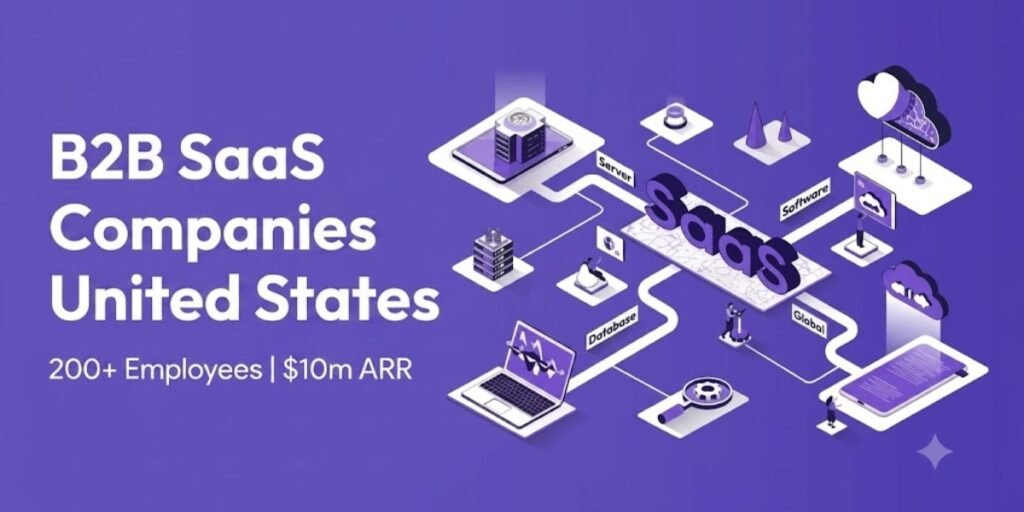
The business-to-business software-as-a-service market in the United States represents an economic powerhouse built on recurring subscription economics, scalable cloud architecture, and mission-critical enterprise deployment. Passing the threshold of $10 million in annual recurring revenue while scaling past 200 employees marks a definitive operational milestone where an emerging technology startup transforms into an established institutional vendor.
Market research from financial disclosures and industry indices shows that elite enterprise SaaS providers maintain average net revenue retention rates exceeding 115% alongside non-GAAP gross margins often surpassing 70%.
These organizations do not merely sell software tools; they embed their operational workflows directly into the core financial, customer, and data architectures of global commerce.
This guide evaluates twenty premier B2B SaaS corporations headquartered in the United States that have scaled past these foundational metrics, detailing their operational focus, market reach, and underlying business dynamics.
How We Selected These B2B SaaS Companies
Selecting an authoritative roster of mature software enterprises requires objective, quantifiable financial and operational parameters rather than subjective popularity metrics. The baseline criteria demand that every candidate company operates a pure business-to-business subscription or consumption software model, maintains its corporate headquarters within the United States, employs a global workforce greater than 200 individuals, and generates verified annual recurring revenue or product revenue well in excess of $10 million.
Public data from Securities and Exchange Commission filings, audited annual reports, and verified market valuation databases serve as the primary sourcing filters.
Organizations that derive their primary revenue from hardware manufacturing, consumer applications, or transactional professional services are deliberately excluded.
This methodology ensures that readers review a clean cohort of scalable, high-margin cloud enterprises that define modern enterprise technology standards.
Top B2B SaaS Companies in the United States with 200+ Employees and $10M+ ARR
| Company | Headquarters | Employees | Estimated ARR/Revenue | Primary SaaS Category | Primary Customers |
| Salesforce | San Francisco, CA | 83,334 | $41.5 Billion | Enterprise CRM & Agentic AI | Global Enterprise |
| ServiceNow | Santa Clara, CA | 27,722 | $13.28 Billion | IT Service & Workflow Automation | Enterprise & Government |
| HubSpot | Cambridge, MA | 8,882 | $3.1 Billion | SMB & Mid-Market Inbound CRM | Mid-Market & SMB |
| Snowflake | Bozeman, MT | 7,000+ | $4.47 Billion | Cloud Data Platform & Analytics | Forbes Global 2000 |
| Datadog | New York, NY | 5,500+ | $2.6 Billion | Cloud Observability & Monitoring | DevOps & Engineering Teams |
| Atlassian | San Francisco, CA | 11,500+ | $4.5 Billion | Collaboration & Project Tracking | Software Development Teams |
| Workday | Pleasanton, CA | 18,800+ | $7.3 Billion | Enterprise HCM & Financial Management | Fortune 500 & Enterprise |
| Okta | San Francisco, CA | 6,000+ | $2.5 Billion | Identity and Access Management | Enterprise IT & Security |
| DocuSign | San Francisco, CA | 7,000+ | $2.7 Billion | Agreement Cloud & E-Signature | Enterprise & Legal |
| GitLab | San Francisco, CA | 2,000+ | $700+ Million | DevSecOps Platform | Engineering & Enterprise |
| Asana | San Francisco, CA | 1,600+ | $700+ Million | Work Management & Collaboration | Knowledge Workers |
| Smartsheet | Bellevue, WA | 3,000+ | $1.0 Billion | Enterprise Work Execution | Project Managers & Enterprise |
| Gong | San Francisco, CA | 1,400+ | $200+ Million | Revenue Intelligence & AI Analytics | B2B Sales Organizations |
| Veeva Systems | Pleasanton, CA | 7,500+ | $2.7 Billion | Life Sciences Cloud Solutions | Pharmaceutical & Biotech |
| Cloudflare | San Francisco, CA | 4,200+ | $1.6 Billion | Web Infrastructure & Cloud Security | Enterprise & Web Properties |
| Confluent | Mountain View, CA | 3,000+ | $900+ Million | Data Streaming & Kafka Cloud | Enterprise Data Architects |
| PagerDuty | San Francisco, CA | 1,000+ | $450+ Million | Incident Response & Operations | IT & Engineering Teams |
| Box | Redwood City, CA | 2,900+ | $1.0 Billion | Cloud Content Management & Security | Regulated Enterprise |
| Procore | Carpinteria, CA | 4,000+ | $1.1 Billion | Construction Management SaaS | General Contractors & Owners |
| Samsara | San Francisco, CA | 3,200+ | $1.1 Billion | Connected Operations & Fleet SaaS | Logistics & Field Services |
1. Salesforce
Salesforce pioneered the modern multi-tenant enterprise software delivery model after its founding in 1999, scaling from a disruptive cloud newcomer into the dominant global customer relationship management titan. Headquartered in San Francisco, California, the enterprise employs 83,334 staff members and closed its fiscal year with record annual revenues reaching $41.5 billion.
The company shifted its strategic direction from legacy relational database structures toward autonomous agentic artificial intelligence solutions, with its Agentforce and Data Cloud product lines scaling at triple-digit year-over-year velocities.
Salesforce targets global Fortune 500 corporations and mid-market sales teams, providing unified cloud suites across sales, service, marketing, and commerce operations.
Their vast partner ecosystem and continuous acquisition strategy, including major integrations like Slack and Tableau, cement their institutional status.
2. ServiceNow
ServiceNow operates as a foundational digital workflow engine that has transformed traditional information technology service management into an enterprise-wide automation platform. Headquartered in Santa Clara, California, the enterprise supports 27,722 employees and generates robust annual subscription revenues exceeding $13.28 billion.
Recent financial disclosures demonstrate exceptional operational momentum, with fourth-quarter subscription revenues hitting $3.466 billion at a 21% year-over-year constant-currency growth rate.
ServiceNow maintains an exceptional customer renewal rate of 98%, driven by deep integration of generative artificial intelligence features within its Now Assist and Workflow Data Fabric suites.
The company services large-scale enterprise and public-sector institutions, counting over 603 customers with annual contract values surpassing $5 million.
3. HubSpot
HubSpot established the modern inbound marketing and sales software category for growing businesses after its launch in 2006, evolving into a dominant mid-market CRM provider. Headquartered in Cambridge, Massachusetts, the company employs 8,882 team members and closed its recent fiscal cycle with annual revenues touching $3.1 billion.
Market metrics show HubSpot serving 288,706 paying customers across more than 135 countries, balancing solid mid-teens revenue growth with expanding operating margins near 22.6%.
The strategic rollout of its Breeze artificial intelligence agent ecosystem allows smaller sales and marketing teams to automate customer engagement workflows without deploying complex enterprise engineering resources.
HubSpot continues to capture market share by bridging the gap between sophisticated data tooling and user-friendly design.
4. Snowflake
Snowflake redefined data storage, sharing, and analytics through its cloud-native consumption-based architecture that decouples compute from storage. Headquartered in Bozeman, Montana, the company coordinates a global workforce exceeding 7,000 personnel and reports annual product revenues approaching $4.68 billion.
Fiscal performance indicators reflect a 29.16% year-over-year revenue expansion, confirming the platform’s vital role within Forbes Global 2000 data infrastructures.
Snowflake integrates secure data collaboration clean rooms with advanced large language model execution, enabling enterprises to query massive cross-cloud data sets without moving raw files.
Their consumption model aligns cost directly with client utility, driving strong customer retention across complex financial, retail, and healthcare sectors.
5. Datadog
Datadog serves as a unified observability, cloud security, and artificial intelligence monitoring platform for modern engineering and DevOps teams. Headquartered in New York, New York, the enterprise manages over 5,500 employees and posts annual revenues of $3.67 billion.
Recent operational telemetry reports 32,700 total customers, with a high-value cohort of 4,550 accounts generating over $100,000 in annual recurring revenue representing roughly 90% of total product revenue.
Datadog continues to innovate rapidly through specialized GPU monitoring for artificial intelligence workloads and autonomous Bits artificial intelligence troubleshooting agents.
Their scalable infrastructure model and strong net retention rates near 120% highlight deep product penetration across distributed multi-cloud architectures.
6. Atlassian
Atlassian anchors software engineering and collaborative project management through iconic workflow products like Jira, Confluence, and Trello. Headquartered in San Francisco, California, the company employs over 11,500 professionals and generates annual revenues exceeding $4.5 billion.
Their transition from traditional server deployments to a high-margin cloud ecosystem has scaled recurring subscription velocity across millions of active developer seats globally.
Atlassian integrates agile planning tools with automated security and knowledge management, making its workspace environment a baseline operational standard for technology teams.
Their continuous focus on artificial intelligence-assisted task summarization and cross-team alignment secures their position as a dominant collaboration vendor.
7. Workday
Workday delivers enterprise-grade human capital management, financial management, and planning software designed for large institutional employers. Headquartered in Pleasanton, California, the enterprise coordinates 18,800+ employees and reports full-year fiscal revenue touching $9.55 billion, driven by $8.83 billion in subscription services.
Recent quarterly performance data shows subscription revenue expansion reaching $2.36 billion, up 15.7% year-over-year, backed by operating cash flows of $2.94 billion.
Workday serves more than 50% of the Fortune 500, embedding its machine learning and agentic artificial intelligence models directly into core payroll, talent analytics, and expense reporting operations.
Their robust backlog, totaling $28.1 billion in total subscription commitments, underlines deep multi-year enterprise lock-in.
8. Okta
Okta manages independent identity verification, single sign-on, and adaptive multi-factor authentication across complex corporate technology stacks. Headquartered in San Francisco, California, the company employs 6,366 professionals and reports full-year revenue of $2.92 billion.
Financial telemetry highlights a 12% year-over-year revenue increase, supported by strong non-GAAP operating income reaching $766 million and free cash flow generation of $863 million.
Okta secures digital entryways for thousands of organizations, transitioning enterprise architectures toward zero-trust security postures.
Their unified customer identity and workforce identity clouds handle billions of daily authentications, shielding enterprise networks against credential stuffing and lateral identity theft vectors.
9. DocuSign
DocuSign digitizes transactional agreements, contract lifecycles, and cryptographic electronic signatures across global legal and commercial operations. Headquartered in San Francisco, California, the company manages 7,000+ staff members and posts annual product revenues of approximately $2.7 billion.
Their Intelligent Agreement Management platform integrates contract generation, automated negotiation workflows, and AI-driven document insights to streamline corporate deal-making.
DocuSign supports hundreds of thousands of enterprise accounts and millions of individual users worldwide, maintaining a firm grip on digital transaction workflows.
Their high-margin subscription model and deep integrations with corporate enterprise resource planning suites ensure persistent utility.
10. GitLab
GitLab delivers a comprehensive DevSecOps platform that streamlines software development, security testing, and deployment operations into a single application framework. Headquartered in San Francisco, California, the enterprise employs over 2,000 professionals and reports surging annual product revenues exceeding $700 million.
Recent performance figures highlight strong subscription expansion, with recent quarterly revenue growing 31% year-over-year to $183 million, backed by non-GAAP operating margins showing consistent improvement.
GitLab leverages its dedicated GitLab Duo artificial intelligence assistant to automate code generation, vulnerability remediation, and merge request summaries across engineering teams.
Their robust adoption among large enterprise clients with annual contract values over $100,000 highlights their critical role in modern software supply chain acceleration.
11. Asana
Asana structures collaborative work management, project tracking, and cross-functional team coordination for modern digital enterprises. Headquartered in San Francisco, California, the company coordinates a global team of 1,600+ employees and generates annual revenues topping $700 million.
Financial reporting underscores solid momentum with core customer adoption, particularly among enterprise accounts spending $100,000 or more annually, which continue to grow at double-digit rates.
Asana integrates its AI-powered Work Graph data model to help organizations map workflows, identify project bottlenecks, and automate status updates without manual micromanagement.
Their enterprise-grade administrative controls and intuitive user interface position them as a preferred operational dashboard for distributed knowledge workers.
12. Smartsheet
Smartsheet operates a scalable enterprise work execution platform that bridges project portfolio management, resource planning, and automated process workflows. Headquartered in Bellevue, Washington, the company employs over 3,000 team members and reports annual revenues reaching the $1.0 billion threshold.
Recent operational updates show subscription revenue retention rates remaining strong at 111%, supported by a growing base of enterprise customers generating $100,000+ in annual contract value.
Smartsheet integrates advanced data-bridging capabilities with automated project intake routines, enabling non-technical business units to build complex operational solutions safely.
Their deep utility across construction, marketing, and professional services reinforces their position as a mature cloud execution standard.
13. Gong
Gong harnesses specialized revenue artificial intelligence to analyze customer interactions across phone calls, video conferences, and emails. Headquartered in San Francisco, California, the company supports 1,400+ employees and has recently surpassed an annual recurring revenue run rate of $500 million, reflecting year-over-year growth exceeding 55%.
Recent strategic performance indices show enterprise adoption accelerating rapidly, with large accounts signing deals worth over $1 million at a pace double that of previous windows.
Gong integrates its proprietary Revenue Graph data layer with advanced generative models to forecast deal risks, measure sales rep capacity, and automate administrative workflows.
Their proven ability to increase seller productivity, such as driving a 64% boost for Anthropic and a 141% win-rate lift for Paycor, establishes them as a vital commercial platform.
14. Veeva Systems
Veeva Systems provides cloud-based software, data management, and regulatory compliance solutions tailored explicitly for the global life sciences and pharmaceutical sectors. Headquartered in Pleasanton, California, the enterprise employs 7,500+ professionals and reports full-year total revenues touching $3.20 billion, anchored by $2.68 billion in subscription services.
Financial disclosures reflect consistent institutional momentum, with total revenues expanding 16% year-over-year and annual net income reaching $908.9 million.
Veeva embeds its specialized industry applications directly into clinical trial tracking, commercial manufacturing compliance, and patient data management workflows.
Their high customer retention and dominant market share across major biotechnology firms solidify their position as an essential vertical cloud leader.
15. Cloudflare
Cloudflare secures, accelerates, and optimizes web applications and edge computing architectures across a massive global network infrastructure. Headquartered in San Francisco, California, the company coordinates 4,200+ employees and posts annual run-rate revenues exceeding $2.3 billion, with first-quarter revenues scaling 34% year-over-year to $639.8 million.
Operational performance metrics show non-GAAP gross margins holding strong above 72.8% alongside robust free cash flow generation.
Cloudflare delivers zero-trust security services, distributed edge worker execution, and automated DDoS mitigation to millions of internet properties and enterprise networks.
Their continuous expansion into developer-focused serverless computing and artificial intelligence inference at the edge positions them at the center of modern cloud infrastructure development.
16. Confluent
Confluent delivers a real-time data streaming platform built around the Apache Kafka ecosystem, allowing enterprises to process continuous streams of event data across hybrid cloud environments. Headquartered in Mountain View, California, the company employs over 3,000 professionals and reports annual product revenues approaching $950 million.
Financial reports highlight continuous top-line expansion, with subscription revenues scaling rapidly as enterprise clients migrate from legacy batch-processing databases to live stream governance tools.
Confluent Cloud manages massive throughput for financial, retail, and telecommunications operations where latency reduction directly impacts transactional velocity.
Their specialized developer focus and high net retention position them as an essential backbone for enterprise event-driven architectures.
17. PagerDuty
PagerDuty operates an essential digital operations management platform that automates incident response, alert routing, and real-time operational triage for engineering fleets. Headquartered in San Francisco, California, the enterprise supports roughly 1,000 employees and posts annual recurring revenues exceeding $450 million.
Operational telemetry shows robust adoption of their automated response workflows and generative artificial intelligence event summarization capabilities among mid-market and enterprise tech stacks.
By cutting through alert fatigue and reducing the manual burden on on-call engineers, PagerDuty protects critical uptime metrics across distributed cloud infrastructure.
Their high gross margins and stable enterprise contract additions underline strong operational durability.
18. Box
Box provides a secure cloud content management and collaboration platform engineered specifically for highly regulated enterprise and government sectors. Headquartered in Redwood City, California, the company manages 2,900+ employees and generates annual revenues right at the $1.0 billion benchmark.
Financial disclosures show stable revenue per employee metrics alongside strong free cash flow generation and the rollout of Box AI capabilities.
Box secures sensitive document workflows, data residency compliance, and automated metadata classification across global enterprise operations.
Their deep integration with industry-standard productivity suites and rigorous compliance certifications keep them entrenched within conservative IT budgets.
19. Procore
Procore anchors construction management software through an integrated collaborative platform that links general contractors, owners, and specialty trade partners. Headquartered in Carpinteria, California, the company employs 4,421 full-time staff and reports total annual revenues reaching $1.32 billion, representing a 15% year-over-year growth rate.
Financial metrics indicate that 78% of total annual recurring revenue comes from customers utilizing four or more products, with over 52% leveraging six or more platform tools.
Procore embeds its financial, project management, and IoT equipment tracking routines into complex field workflows, driving high retention across cyclical building markets.
Their operational efficiency and FedRAMP Moderate authorizations expand their footprint into large-scale public infrastructure projects.
20. Samsara
Samsara drives connected operations by combining IoT hardware data with a cloud-based software dashboard for physical operations and commercial fleets. Headquartered in San Francisco, California, the enterprise employs 3,200+ professionals and generates annual recurring revenues exceeding $1.1 billion.
Market momentum indices show strong enterprise scaling, particularly with large fleets deploying telematics, driver safety tracking, and equipment monitoring routines.
Samsara transforms physical operational data into actionable software insights that reduce fuel consumption, prevent workplace incidents, and streamline logistics.
Their high-margin SaaS model, combined with heavy physical utility, establishes them as a unique and dominant player in industrial cloud technology.
Which Industries Depend Most on Large B2B SaaS Platforms?
Enterprise cloud consumption clusters heavily around specific commercial sectors with complex regulatory or massive scale demands. Financial services and banking rely on workflow automation and security platforms like ServiceNow and Okta to handle strict compliance and identity governance. Healthcare and life sciences deploy specialized platforms like Veeva Systems to manage rigorous clinical data constraints and patient privacy mandates.
Technology and software development sectors utilize Atlassian, Datadog, and GitLab to maintain distributed engineering velocity and continuous uptime.
Logistics, construction, and field services depend on vertical operations software like Procore and Samsara to monitor physical assets and coordinate field productivity in real time.
These industries treat software expenditures as foundational capital outlays rather than discretionary operational expenses.
Enterprise Buying Factors Beyond Revenue and Employee Count
Evaluating enterprise software stability requires examining metrics that speak to long-term commercial durability. Net Revenue Retention (NRR) serves as a primary indicator, with top-tier vendors consistently maintaining retention rates above 110% through organic customer expansion.
Decision makers also prioritize gross margin stability, looking for non-GAAP gross margins that exceed 70%, which prove the underlying efficiency of multi-tenant cloud delivery models.
Evaluating the volume of six-figure and seven-figure annual contract value customers reveals true enterprise penetration versus reliance on fragile small-business volume.
Finally, platform extensibility and integration depth dictate whether a software asset can survive enterprise architecture consolidation cycles.
Frequently Asked Questions
What qualifies as a B2B SaaS company?
A business-to-business software-as-a-service company delivers applications and data platforms over the internet on a recurring subscription or consumption pricing model to corporate or institutional clients rather than individual consumers.
Why use employee count and ARR as selection criteria?
Passing 200 employees and $10 million in annual recurring revenue signals that a technology enterprise has successfully moved past early startup volatility into stable, repeatable operational maturity.
What does $10 million ARR indicate about a SaaS company?
Generating $10 million in recurring revenue indicates product-market fit, a validated enterprise sales motion, and predictable cash flow generation capable of sustaining continuous research and development.
Are all companies on this list headquartered in the United States?
Yes, every corporation featured in this evaluation maintains its primary corporate headquarters within the United States.
Which industries spend the most on enterprise B2B SaaS?
Regulated and data-intensive verticals like financial services, life sciences, telecommunications, and enterprise technology represent the highest-spending cohorts in the cloud software market.
What Distinguishes Mature B2B SaaS Companies from Smaller Vendors?
Mature providers offer robust enterprise-grade security compliance, dedicated multi-region support, deep API integration ecosystems, and audited financial stability that smaller point solutions cannot match.
Which of these companies primarily serve enterprise customers?
Industry giants like Salesforce, ServiceNow, Snowflake, Workday, and Veeva Systems focus almost exclusively on large-scale Forbes Global 2000 and institutional enterprise accounts.