On a quiet Tuesday afternoon, a water treatment plant operator in a small town notices their cursor moving across the screen, independent of their mouse. Within seconds, the software controlling the facility’s sodium hydroxide levels begins manipulating the chemical ratios, spiking them to highly toxic levels. This is not a hypothetical scenario or a scene from a Hollywood movie. It is a documented cyberattack on municipal infrastructure, and it highlights a critical reality. The systems that keep our physical world running are now firmly in the crosshairs of global cyber adversaries.
Historically, the computers running factory floors, power grids, and transit networks lived in isolated digital ecosystems. They were physically separated from the internet and the corporate office. Today, that air gap is dead. The push for real-time data analytics, predictive maintenance, and operational efficiency has permanently fused corporate Information Technology, or IT, with physical Operational Technology, known as OT.
This digital convergence has unlocked immense economic value, but it has also exposed fragile, legacy industrial hardware to the open internet. When an enterprise IT system is breached, files are locked, emails go down, and business pauses. When an OT system is breached, generators can spin out of control, pipelines can rupture, and entire cities can lose power. Safely managing these physical risks requires a fundamental departure from traditional corporate cybersecurity strategies.
What Is Operational Technology Cyber Security?
While IT focuses on the flow, storage, and security of digital data, OT is the category of hardware and software designed to monitor and directly control physical equipment, assets, and processes.
OT exists to execute physical actions in the real world. When a sensor detects that a steel vat is too hot, OT software tells a valve to open, releasing coolant. When a train approaches a bend, OT systems manage the braking pressure. IT lives in the virtual space of spreadsheets, databases, and websites, while OT operates in the physical realm of pressure, temperature, motion, and electricity.
Securing OT requires a complete inversion of traditional IT security priorities. Standard IT security is built on the CIA triad, prioritizing Confidentiality first, Integrity second, and Availability third. In the industrial world, this model is turned on its head to prioritize availability and safety above all else.
Keeping a cooling pump running at a nuclear facility is infinitely more important than preventing an unauthorized user from reading the pump’s data transmission. An unexpected reboot to apply a security patch might be a minor inconvenience for an office employee, but the same reboot on an assembly line can trigger emergency shutdowns, ruin millions of dollars in inventory, or endanger the lives of technicians on the floor.
Because OT interacts directly with physical matter, cyber incidents in these environments do not stop at digital theft. They carry real-world consequences. A compromised industrial network can result in environmental spills, structural fires, equipment destruction, and severe physical harm to workers and surrounding communities.
Where Operational Technology Is Used
Operational technology serves as the nervous system for modern civilization, quietly powering the critical infrastructure that sustains daily life. The processes controlled by OT vary wildly across sectors, but they all share a reliance on automation to govern physical outcomes.
Manufacturing Plants
Modern factories rely on highly coordinated assembly lines where robotic arms, conveyor belts, and chemical mixers must operate with millimeter precision. OT systems synchronize these movements, monitor raw material feeds, and regulate curing ovens to maintain product quality and worker safety.
Energy Generation and Distribution
Electrical grids are arguably the most complex machines ever built. OT systems manage the rotational speed of turbine generators, regulate the voltage stepping up or down at substations, and route electricity across thousands of miles of transmission lines to prevent blackouts.
Oil and Gas Facilities
From offshore drilling platforms to thousands of miles of cross-country pipelines, OT manages the flow of highly volatile liquids and gases. It controls high-pressure pumps, monitors safety valves for leaks, and regulates the refining processes that turn crude oil into usable fuel.
Water and Wastewater Treatment
Clean drinking water depends on automated chemical dosing systems controlled by OT. These systems measure water turbidity, inject precise amounts of chlorine or ozone, control massive filtration pumps, and manage the aeration basins in sewage treatment plants.
Transportation Systems
Subways, freight railways, and air traffic control systems depend heavily on OT. It coordinates track switching to prevent collisions, manages signaling lights, controls drawbridges, and regulates the ventilation fans inside long highway tunnels.
Smart Buildings
Large commercial properties and high-rises use OT to manage environmental and structural systems. This includes central heating, ventilation, and air conditioning systems, elevator banks, automated fire suppression systems, and building access control gates.
Healthcare Facilities
While medical records sit on IT servers, the physical infrastructure of a hospital relies on OT. Back-up diesel generators, specialized air filtration systems for surgical suites, and pneumatic tube systems for transporting lab samples are all managed by industrial automation.
Mining Operations
In deep underground mines and vast open-pit operations, OT controls autonomous haul trucks, runs massive ventilation shafts that prevent toxic gas buildup, and monitors the stability of conveyor systems transporting tons of raw ore.
The Technologies That Make Up an OT Environment
An industrial facility is not just a collection of computers. It is a multi-layered ecosystem of mechanical devices, digital controllers, and human interfaces that must work in perfect harmony.
To help visualize how these technologies interact, we can look at the industry-standard Purdue Model, which segments industrial networks into functional levels:
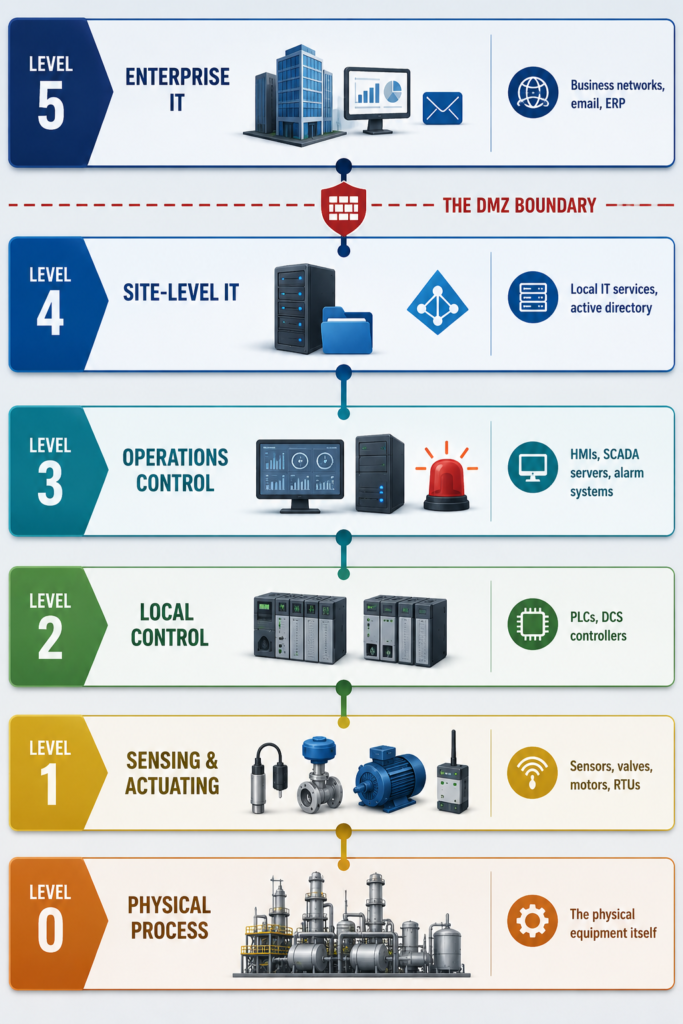
Here is what these component technologies actually do within this stack:
Industrial Control Systems (ICS)
This is the umbrella term used to describe the entire integration of hardware, software, and network connectivity used to operate and support industrial processes. Any system that monitors or controls physical equipment falls under the ICS umbrella.
Supervisory Control and Data Acquisition (SCADA)
SCADA is a system architecture designed for high-level, wide-area monitoring and control. A SCADA system gathers real-time data from multiple distant sites, such as several different pumping stations along a pipeline, and centralizes that information on a screen in a master control room.
Programmable Logic Controllers (PLC)
These are ruggedized, solid-state industrial computers designed to operate reliably in harsh environments like extreme heat, cold, or vibration. PLCs receive data from input sensors, process that data based on pre-programmed logic, and send instructions to physical actuators, like telling a motor to stop when a box reaches the end of a conveyor.
Distributed Control Systems (DCS)
Unlike a PLC which typically controls a single machine, a DCS is used to manage highly complex, continuous manufacturing processes within a single location, such as a chemical refinery. Control is distributed throughout the plant with multiple localized controllers connected to a central monitoring hub.
Remote Terminal Units (RTU)
An RTU is a microprocessor-based electronic device that interfaces physical objects with SCADA systems. They are deployed in remote, harsh locations to collect data from sensors, convert that data into digital formats, and transmit it back to the central SCADA master database via radio, cellular, or satellite links.
Human-Machine Interfaces (HMI)
An HMI is the visual dashboard or touchscreen that allows a human operator to interact with industrial machines. It translates complex machine data into graphical representations, showing red lights for alarms, green lights for normal operations, and dials indicating system pressure.
Industrial Sensors and Actuators
Sensors are the eyes and ears of the OT environment, measuring physical properties like temperature, pressure, flow rate, or vibration. Actuators are the muscles, taking digital signals from a PLC or RTU and converting them into physical movement, such as opening a valve, turning a gear, or heating a coil.
Industrial Communication Protocols
These are the specialized digital languages that industrial devices use to talk to each other. Unlike modern IT networks that use highly standardized and encrypted protocols, legacy OT devices often communicate using older, unencrypted protocols such as Modbus, Profibus, or DNP3, which were designed decades ago with zero built-in security features.
Why Operational Technology Requires a Different Security Strategy
Applying corporate IT security policies directly to an OT environment is a recipe for operational failure. The technical constraints, operational realities, and core priorities of the factory floor are fundamentally different from those of the corporate office.
Understanding these differences is crucial for anyone trying to defend industrial systems.
- Continuous Uptime Requirements: In an IT environment, a server can often be taken offline for maintenance at midnight or over the weekend. In OT, critical infrastructure systems must run 24 hours a day, 7 days a week, 365 days a year. Any unscheduled downtime can cost millions of dollars per hour or disrupt public services.
- Worker and Public Safety: A software failure in an IT system might corrupt a database. A software failure in an OT system can cause a boiler to over-pressurize and explode, directly endangering the lives of nearby technicians. Safety is the ultimate metric in OT design.
- Equipment Reliability and Longevity: While corporate laptops and servers are typically replaced every three to five years, industrial assets like turbines, pumps, and manufacturing presses are massive capital investments built to last 20 to 30 years. This means OT security professionals must protect hardware designed long before the modern internet existed.
- Legacy Operating Systems: Because industrial machinery has such a long lifespan, the computers controlling them often run outdated, unsupported operating systems like Windows XP, Windows 7, or custom real-time operating systems for which security patches no longer exist.
- Limited Maintenance Windows: Applying security updates in an OT environment cannot be automated. Patches must be meticulously tested in offline staging environments to ensure they will not conflict with proprietary industrial software. They can only be deployed during rare, pre-planned plant shutdowns that may occur only once or twice a year.
- Vendor-Certified Software: Many industrial machines are sold as turnkey systems. If an asset owner installs a third-party security tool or modifies the operating system without the explicit approval of the Original Equipment Manufacturer, they risk voiding the multi-million dollar warranty on the machinery.
How Modern Cyber Threats Target Industrial Operations
The days of assuming an industrial network is safe because it is physically isolated are over. Modern attackers use sophisticated, multi-stage pathways to bridge the gap between corporate networks and physical control rooms.
Understanding how these attack paths work is the first step toward blocking them.
Ransomware Spreading into OT
Most ransomware does not target PLCs directly. Instead, it enters the corporate IT network through standard phishing emails, encrypts corporate servers, and then migrates across poorly segmented network boundaries into the industrial zone. Even if the malware only encrypts the HMIs and SCADA databases, operators lose visual control of the physical process, forcing them to shut down operations out of caution.
Compromised Remote Access
To reduce travel costs, industrial equipment vendors and third-party maintenance contractors frequently use remote desktop software or Virtual Private Networks to monitor and service industrial assets from afar. If an attacker steals these remote access credentials, they can log directly into the industrial control network as a trusted user and manipulate physical processes without triggering traditional network alarms.
Phishing and Corporate Exposure
Attackers often target engineers, plant managers, or maintenance planners with highly targeted phishing emails. Once a workstation on the corporate side is compromised, attackers use it as a launching pad to harvest network credentials, map out the internal network structure, and find pathways leading down to the OT environment.
Insecure Third-Party Vendors and Supply Chains
Industrial facilities rely on a vast network of suppliers, contractors, and integrators. Attackers can compromise a trusted vendor’s software update mechanism or plant diagnostic tools. When the industrial facility installs what they believe is a routine software update, they inadvertently introduce malicious code deep inside their secure perimeter.
Unsecured Industrial Protocols
Because legacy communication protocols like Modbus do not require authentication or encryption, anyone who gains access to the local OT network can send commands directly to a PLC. An attacker does not need to exploit a complex software vulnerability. They simply write standard industrial commands to tell a controller to shut down a pump or modify a safety threshold, and the device will obediently execute the command.
Insider Threats
Whether it is a disgruntled employee, a compromised contractor, or a bribed technician, individuals with legitimate physical access to a plant pose a massive risk. A single infected USB drive plugged into a maintenance workstation can bypass every layer of network firewall security instantly.
Lessons From Real-World OT Cyberattacks
We do not have to guess how OT cyber warfare looks in practice. The history of the past two decades is marked by increasingly sophisticated attacks that transitioned from experimental code to highly disruptive physical realities.
Stuxnet (2010)
Widely considered the world’s first true cyber weapon, Stuxnet was a highly complex worm designed to target specific Siemens PLCs controlling centrifuges at a nuclear enrichment facility in Natanz, Iran.
- How access was gained: The malware was introduced via infected USB flash drives, bypassing the facility’s air-gapped network defense.
- Operational impact: Stuxnet secretly manipulated the rotational speeds of the centrifuges, causing them to tear themselves apart, while simultaneously feeding normal operational data back to the HMI screens so operators believed everything was running perfectly.
- The lesson: Physical isolation is not an absolute barrier against targeted, sophisticated attacks.
Ukraine Power Grid Attack (2015)
This was the first publicly acknowledged cyberattack to successfully take down a civilian electrical grid, leaving over 230,000 residents in western Ukraine without power in the dead of winter.
- How access was gained: Attackers used spear-phishing emails to steal credentials and gain access to the corporate IT network, then navigated to the SCADA network where they compromised remote access accounts.
- Operational impact: The attackers literally took control of the operators’ HMI screens, systematically opened circuit breakers at 30 substations, locked operators out of their systems, and wiped server hard drives to delay recovery.
- The lesson: Strong multifactor authentication is non-negotiable for all remote access pathways entering the industrial control network.
Colonial Pipeline Ransomware (2021)
This attack shut down the largest refined oil pipeline system in the United States, causing widespread fuel panics, long lines at gas stations, and skyrocketing fuel prices across the East Coast.
- How access was gained: Attackers gained entry to the corporate IT network using a leaked password for an old, unused Virtual Private Network account that did not have multifactor authentication enabled.
- Operational impact: While the ransomware only encrypted the corporate IT billing and business networks, Colonial Pipeline chose to proactively shut down the pipeline’s physical OT delivery systems out of fear that the malware could migrate to the control networks or because they could no longer track fuel shipments for billing.
- The lesson: IT and OT systems are highly interdependent, and a lack of business continuity planning can force a physical shutdown even if the OT network itself remains untouched.
Triton/Trisis Malware (2017)
Discovered at a petrochemical plant in Saudi Arabia, Triton was specifically engineered to target Safety Instrumented Systems, which are the highly specialized controllers designed to act as a plant’s last line of defense against catastrophic failures.
- How access was gained: Attackers compromised an engineering workstation that was connected to both the corporate network and the safety network.
- Operational impact: The malware modified the memory of the safety controllers, aiming to disable their emergency shutdown capabilities. A programming error in the malware triggered an unexpected shutdown, alerting operators to the presence of the attack before a physical disaster could be initiated.
- The lesson: Safety systems must be physically and logically isolated from standard control networks to prevent attackers from disabling physical fail-safes.
Building a Resilient Operational Technology Security Program
Securing an industrial environment is not about buying a single piece of security software. It requires a structured, multi-layered framework tailored to the unique physical risks of the facility.
An effective defense-in-depth program should focus on these core pillars:
Asset Discovery
You cannot protect what you do not know exists. Many industrial sites have undocumented legacy devices, rogue wireless access points installed by contractors, or older PLCs tucked away in remote cabinets. Organizations must build a comprehensive, real-time inventory of every hardware asset, firmware version, and software application connected to their network.
Because active scanning tools can crash sensitive legacy PLCs, this inventory is best compiled using passive network monitoring tools that listen to traffic without injecting disruptive packets.
Network Segmentation
The corporate network and the industrial network must be completely isolated from one another. This is best achieved by implementing the Purdue Model and establishing an industrial Demilitarized Zone, or DMZ.
No direct communication should ever occur between an enterprise IT system and a physical OT controller. All traffic must terminate in the DMZ, where data can be safely inspected, scrubbed, and passed along through secure proxies.
Secure Remote Access
Any external path into the OT environment is a high-priority target for attackers. All remote connections, whether used by internal engineers or external vendors, must require multi-factor authentication, use dedicated jump hosts, and be active only for the specific duration of the maintenance window.
All remote sessions should be fully logged, monitored, and recorded for audit purposes.
Continuous Monitoring
Industrial networks are highly predictable. Under normal conditions, a PLC talks to a specific HMI using standard, repetitive commands. Continuous monitoring systems baseline this normal behavior and flag any anomalies immediately.
If a PLC suddenly attempts to communicate with an unknown device on the network, or if an HMI sends a command to write new firmware to a controller, the security team must be alerted instantly to investigate.
Vulnerability Management
Applying every single software patch as soon as it is released is impossible in an OT environment. Instead, organizations must adopt a risk-informed approach to vulnerability management.
Teams should prioritize patching vulnerabilities that are actively being exploited in the wild, have known public exploits available, or reside on critical, internet-facing assets, while using compensating controls like network segmenting to protect less critical interior devices.
Backup and Recovery
When a destructive attack or ransomware strike occurs, rapid recovery is the difference between a minor disruption and a multi-week shutdown. Organizations must maintain secure, offline backups of all PLC logic, HMI configurations, and SCADA database schemas.
These “gold image” backups must be stored in a way that prevents them from being encrypted by the same ransomware that infected the primary network.
Incident Response
A standard IT incident response plan is useless when physical machinery is behaving erratically. OT-specific incident response playbooks must be developed, detailing how to safely isolate compromised network segments without causing sudden, dangerous shutdowns of physical equipment.
These playbooks should be regularly practiced through joint tabletop exercises involving both security personnel and physical plant operators.
Why IT and OT Teams Must Work Together
For decades, IT departments and OT engineering teams lived in completely different worlds, speaking different languages, and harboring mutual distrust.
The IT team viewed the OT engineers as reckless for running unpatched, outdated operating systems. The OT engineers viewed the IT team as dangerous because an automated IT antivirus scan could freeze a critical control workstation mid-process.
To build a resilient security posture, this cultural divide must be bridged through structured collaboration:
- Shared Visibility: Security operations centers must have visibility into both enterprise networks and industrial control traffic, allowing analysts to spot a lateral movement attempt before it breaches the OT boundary.
- Joint Risk Management: Risk assessments should involve both IT cybersecurity specialists who understand modern threat vectors and OT engineers who understand the physical failure modes of the machinery.
- Coordinated Incident Response: When an alert is triggered, IT and OT teams must respond together. The IT team can handle network isolation and forensics, while the OT team ensures that any containment actions do not jeopardize human safety or equipment integrity.
- Unified Governance: Organizations must establish clear lines of responsibility, ensuring that industrial cybersecurity is treated as a core business risk with executive oversight, rather than an isolated engineering headache.
Security Standards That Shape Modern OT Protection
Industrial organizations do not need to invent their security strategies from scratch. Several mature, globally recognized standards frameworks exist to guide the implementation of effective OT security programs.
IEC 62443
This is the international standard for the security of Industrial Automation and Control Systems, developed jointly by the International Society of Automation and the International Electrotechnical Commission. It provides a comprehensive framework addressing security processes, system design, and product development.
Importantly, IEC 62443 establishes the concept of security levels and defines how to split an industrial network into secure “zones and conduits” to limit the lateral spread of cyber threats.
NIST SP 800-82
Published by the National Institute of Standards and Technology, this special publication provides specific guidance on how to secure industrial environments, including SCADA, DCS, and PLCs. Its most recent version, Revision 3, released in 2023, was retitled the Guide to Operational Technology Security, expanding its scope from Industrial Control Systems to the broader OT landscape, including building automation and physical access control systems.
It translates standard cybersecurity principles into practical recommendations that respect the unique performance, safety, and reliability requirements of industrial environments.
NIST Cybersecurity Framework
While designed for general use, the NIST Cybersecurity Framework is widely adopted by critical infrastructure operators to assess their cybersecurity maturity and communicate risk to executive leadership. The current version, CSF 2.0, released in February 2024, is structured around six core functions: Govern, Identify, Protect, Detect, Respond, and Recover, with the Govern function added to emphasize that cybersecurity is an enterprise-wide risk management responsibility.
Emerging Trends in Operational Technology Cyber Security
As we look toward the future, the complexity of protecting operational technology continues to accelerate. The next generation of industrial security will be shaped by several emerging technologies and paradigms.
AI-Assisted Threat Detection
With industrial networks producing vast amounts of telemetry data, machine learning algorithms are increasingly used to detect subtle patterns indicative of a cyberattack. These systems can analyze thousands of sensor readings simultaneously to spot minor, coordinated manipulations that a human analyst might easily miss.
Zero Trust for Industrial Networks
The concept of Zero Trust, never trust, always verify, is migrating from corporate IT to the factory floor. This involves micro-segmenting internal industrial networks so that even devices within the same zone must continuously authenticate and verify their identity before they are allowed to communicate.
Secure-by-Design Industrial Systems
Recognizing the limitations of retrofitting security onto legacy hardware, major industrial equipment manufacturers are moving toward secure-by-design engineering. Future generations of PLCs and smart sensors will feature built-in cryptographic hardware, encrypted communication protocols, and tamper-resistant boot processes as standard features.
Conclusion
Operational technology cybersecurity is no longer just a technical challenge hidden away on the factory floor. It has grown into a fundamental pillar of national security, economic stability, and public safety. The rapid convergence of physical machinery with digital networks has permanently reshaped the threat landscape, transforming physical plants into highly attractive targets for cybercriminals and nation-state adversaries alike.
Protecting these systems requires a profound shift in mindset. We must move past the outdated assumption that physical isolation is a viable defense and instead build resilient, defense-in-depth architectures designed specifically for the unique physical realities of industrial operations. By fostering deep collaboration between IT and OT teams, adhering to proven security standards, and prioritizing safety and operational continuity, organizations can successfully defend the vital infrastructure that keeps our physical world moving.
Frequently Asked Questions
What is the difference between IT security and OT security?
IT security focuses on protecting data confidentiality and integrity within office environments. OT security focuses on protecting the availability, reliability, and physical safety of machines and automated processes operating in the real world.
What is an Industrial Control System (ICS)?
An ICS is an integration of hardware and software designed to monitor, control, and automate physical processes in industrial environments. It includes technologies like PLCs, SCADA networks, and distributed control systems.
Why are legacy OT systems difficult to secure?
Legacy systems often lack basic security features like encryption, user authentication, or logging. They frequently run outdated operating systems that cannot be patched easily without risking operational downtime or voiding equipment warranties.
Can ransomware affect operational technology?
Yes. While ransomware rarely targets physical controllers directly, it can encrypt the human-machine interfaces, engineering workstations, and database servers needed to monitor and manage physical operations, forcing a complete operational shutdown.
Which industries rely most on operational technology?
Critical infrastructure sectors rely most heavily on OT, including electricity generation, oil and gas refining, water treatment, chemical manufacturing, transportation networks, and pharmaceutical production.