Cloud computing permanently altered the mechanics of software delivery long before artificial intelligence decentralized traditional computing models. Within the cloud framework, Platform as a Service, commonly known as PaaS, remains a frequently misunderstood architecture. It is far more than a basic hosting layer or a graphical interface for code deployment.
In enterprise environments, PaaS serves as an operational abstraction system that completely decouples infrastructure management from the software development lifecycle. By absorbing the complexity of low-level system configuration, it provides a stable environment for modern applications.
Today, this model serves as the technological engine behind consumer software startups, complex banking APIs, real-time Internet of Things ecosystems, and enterprise automation pipelines. Evaluating PaaS requires looking beyond introductory service definitions.
True analysis means exploring how modern software scales, secures its data flow, and maintains operational continuity in an interconnected cloud landscape.
What Is PaaS in Cloud Computing?
Platform as a Service represents a distinct division of responsibility in cloud architecture. It provides engineering teams with a fully runtime-ready environment accessible over the internet, omitting the need to provision raw hardware or handle low-level network engineering.
Under a traditional on-premises or legacy framework, an organization had to absorb massive capital expenditure and engineering hours to maintain a reliable system stack. Engineers manually handled a multi-tiered progression of tasks:
- Procuring physical servers and configuring data center rack space
- Installing, licensing, and patching server operating systems
- Configuring physical and virtual switch networks alongside load balancers
- Stitching together runtime engines, specialized middleware, and database binaries
- Manually deploying system security updates and tracking hardware depreciation
PaaS transforms this paradigm by converting raw physical and virtual assets into a single managed utility. The cloud provider assumes the entire burden of structural maintenance, system optimization, hardware updates, and hypervisor patching.
The customer interacts primarily with the application tier, managing deployment scripts, API configurations, and data workflows. This specific division of labor establishes PaaS as a highly strategic operational middle layer positioned precisely between bare infrastructure and completed software solutions.
Why PaaS Became Critical to Modern Software Engineering
The structural shift toward PaaS is fundamentally tied to the changing economics and velocity of software delivery. Modern enterprises no longer operate on quarterly or annual release schedules. Competition requires continuous integration and continuous deployment, where microservices and application code updates roll out multiple times per day.
Attempting to sustain this pace while manually configuring physical servers, virtual instances, or firewall ports introduces severe operational friction. PaaS structures remove this bottleneck by standardizing the target environments, ensuring that code behaves identically across staging, testing, and production environments.
A high-grade PaaS ecosystem accelerates this cycle by embedding critical automation capabilities directly into the core platform architecture:
- Automated staging environments and code compilation engines
- Direct hooks for continuous integration and continuous deployment pipelines
- Elastic auto-scaling mechanisms that adapt instantly to erratic traffic surges
- Native telemetry, logging aggregation, and application health monitoring
- Pre-configured container orchestration networks and localized service discovery
This automation shifts engineering hours away from secondary infrastructure management and redirects them toward building core product features. For organizations built around modern DevOps frameworks, PaaS operates as the foundational layer that preserves velocity without sacrificing structural consistency.
The Core Architecture Behind Platform as a Service
Enterprise deployment requires looking beneath simple web dashboards to understand the multi-layered software architecture that keeps PaaS systems functional and reliable.
Infrastructure Abstraction Layer
The lowest operational tier of a PaaS system consists of physical hardware, software-defined networking, and virtualization technologies. This includes distributed arrays of bare-metal servers, physical switches, storage area networks, hypervisors, and isolated availability zones.
PaaS completely hides these components behind advanced virtualization layers. The developer never issues commands directly to a hypervisor or configures a physical network routing table, as the platform automatically slices and exposes these underlying resources as uniform, programmatic assets.
Runtime Environment Layer
Applications cannot execute without a standardized environment containing the necessary language interpreters, compilers, and system dependencies. PaaS systems include fully maintained runtimes tailored for diverse enterprise languages:
- Python execution environments optimized for data processing and AI workloads
- Java virtual machines pre-configured for high-throughput enterprise systems
- Node.js and Go environments built for asynchronous web services and low-latency APIs
- Legacy support frameworks for languages like PHP, Ruby, and native .NET stacks
The platform provider monitors these runtimes, instantly applying critical security updates and keeping underlying software packages clean. This prevents the common operational vulnerability where individual applications run on unpatched or drifting local runtime versions.
Middleware and Service Integration Layer
Modern applications rarely exist as isolated codebases; they require complex support systems to handle communication, state preservation, and data storage. PaaS platforms incorporate ready-to-use middleware components directly into the application space:
- Managed object caches and distributed key-value stores to optimize memory performance
- Enterprise message queues and event streaming buses for asynchronous decoupling
- Unified API gateways that regulate traffic routing, rate limiting, and request validation
- Centralized authentication engines and identity access control brokers
Having these components natively integrated saves engineering teams from spending months manually linking third-party messaging systems or configuring complex database connectors.
Deployment and Orchestration Layer
The final layer manages the lifecycle of the application code itself, transforming a developer’s repository push into an active, globally distributed service. This tier utilizes automated container orchestration to distribute workloads across available compute nodes based on real-time resource utilization.
Advanced PaaS architectures use this layer to safely manage complex deployment techniques, such as blue-green transitions and canary releases. By automating routing shifts between parallel code environments, the platform eliminates the risk of application downtime during production updates.
The Real Difference Between PaaS, IaaS, and SaaS
Understanding Platform as a Service requires looking past simplistic cloud marketing diagrams. The true distinction among the primary cloud service models is determined by a strict division of operational ownership and control. As an engineering team moves up the cloud abstraction ladder, they trade low-level infrastructure configuration for deployment velocity.
In an Infrastructure as a Service (IaaS) model, the cloud vendor operates merely as a digital landlord. They supply virtualized compute instances, storage volumes, and raw networking rails. The customer retains full administrative root access, meaning internal IT operations must still install the operating system, configure middleware binaries, manage runtime execution environments, and deploy local security patches.
PaaS redefines this boundary by drawing a clear line at the application layer. The provider entirely manages everything below your execution logic. This eliminates the need for dedicated system administrators to configure the base infrastructure stack, enabling software engineers to focus purely on code architecture and data schemas.
At the top of the stack sits Software as a Service (SaaS). In this configuration, the end-user has zero exposure to infrastructure, runtime libraries, or codebase deployments. The consumer simply logs into a finished product, managing only basic application settings and localized user permissions.
| Operational Feature | Infrastructure as a Service (IaaS) | Platform as a Service (PaaS) | Software as a Service (SaaS) |
| Infrastructure Access | Direct access to hypervisors, VMs, and networks | Completely abstracted behind managed APIs | No access to underlying infrastructure |
| Customer Control | High: Manages OS, runtime, and network routing | Medium: Controls application logic and data schemas | Low: Configures basic end-user permissions |
| Primary Target User | Network architects and system administrators | Software developers and DevOps engineers | End-business users and consumers |
| Typical Use Cases | Large-scale migrations, disaster recovery, raw hosting | Rapid application delivery and API management | Customer relationship management, email, file sharing |
How PaaS Changes the Economics of Software Delivery
The decision to adopt a PaaS model is as much a financial strategy as it is an architectural choice. In traditional on-premises or unmanaged infrastructure environments, organizations routinely suffer from structural overprovisioning.
To prevent catastrophic system failures during predictable annual traffic surges, a business must invest significant capital expenditure (CapEx) to buy hardware capable of handling peak capacity. During typical operating periods, that expensive hardware sits largely idle, draining operational expenditure (OpEx) via data center power, cooling, and maintenance fees.
PaaS shifts this entire dynamic toward an elastic, demand-driven financial framework. The model relies heavily on dynamic resource pricing structures:
- Pay-As-You-Go Pricing: Charges are calculated directly from active compute metrics, tracking memory allocation per gigabyte-hour and CPU cycles utilized per second.
- Fixed-Resource Capacity Provisioning: Organizations purchase dedicated resource pools for predictable core workloads, scaling out horizontally only when demand breaches predetermined performance baseline thresholds.
By deploying applications onto a fully managed platform, a business can scale up resources instantly during unexpected traffic spikes and shed that capacity the moment demand normalizes. This high elasticity reduces upfront asset costs and optimizes resource efficiency, allowing startups and enterprises alike to fund features rather than idle server capacity.
The Shared Responsibility Model in PaaS
One of the most critical operational risks in cloud computing is assuming that a fully managed platform implicitly guarantees total application security. In a PaaS environment, security operates under a strict, legally binding split framework known as the Shared Responsibility Model.
The line of demarcation dictates that the cloud provider is explicitly responsible for the security of the cloud, while the customer remains fully accountable for the security in the cloud.
The Cloud Provider Secures:
The vendor maintains the physical and structural layer of the development environment. Their security envelope encompasses:
- Physical data center access points, perimeter security, and hardware destruction protocols
- Hypervisor integrity, server clustering virtualization layers, and storage arrays
- Operating system baseline builds, automatic kernel patching, and runtime security hardening
- Core software-defined networking switches and managed middleware infrastructure
The Customer Secures:
The development team retains full ownership of everything they build or inject onto the platform. The customer must configure:
- Application Code Integrity: Writing secure code to block severe exploits like SQL injection, cross-site scripting (XSS), and remote code execution vulnerabilities.
- Data Governance and Encryption: Setting up transport layer security (TLS) for data in transit and configuring AES-256 keys for tokenized databases at rest.
- Identity and Access Management (IAM): Enforcing strict multi-factor authentication (MFA) and setting granular role-based access controls (RBAC) to ensure only authorized personnel can push code to production repositories.
- Regulatory Compliance Policies: Ensuring that data collection workflows inside the application conform directly to legal frameworks such as GDPR or HIPAA.
PaaS and the Rise of Cloud-Native Development
The shift from monolithic software architectures to distributed systems redefined the baseline requirements for modern enterprise platforms. Legacy development relied on packing an entire business suite into a single, massive codebase that executed on a dedicated virtual machine. Modern engineering relies on cloud-native development, an architectural methodology where applications are built as collections of small, independent, and highly cooperative microservices.
PaaS platforms act as the primary operational accelerator for this architectural model. Microservices introduce complex infrastructure challenges, as managing fifty distinct codebases requires vastly more operational overhead than managing a single monolith. A production-grade platform addresses this by embedding container orchestration tools, service meshes, and dynamic internal network routing directly into the environment layer.
Software engineers use these built-in systems to run containers without needing to build, configure, or maintain a custom cluster topology. The platform automatically handles internal service discovery, balances communication traffic among container instances, and isolates faulty processes before they impact the broader system ecosystem.
This structural integration changes how teams approach software lifecycle management. By standardizing the runtime layer across every stage of development, the platform removes environmental variations between an engineer’s local machine, the testing sandbox, and production clusters.
Enterprise Use Cases Where PaaS Delivers the Most Value
While generic hosting can accommodate simple websites, specific digital initiatives require the comprehensive, automated toolsets built into modern platform services.
SaaS Product Development
Building a modern Software as a Service product requires complex underlying systems to manage multi-tenant isolation, subscription billing integrations, and rapid deployment cycles. Engineering teams utilize PaaS to launch software products quickly because the platform handles the underlying infrastructure, allowing developers to focus entirely on building core user features.
The integrated continuous integration and continuous deployment frameworks let teams push feature updates and hotfixes multiple times a day without causing application downtime.
API Platforms
Modern enterprise strategies rely heavily on exposing secure Application Programming Interfaces to external partners, mobile front-ends, and third-party developers. Platforms provide native api gateways that handle request throttling, rate limiting, and open authentication protocols out of the box.
This structural foundation allows companies to build, version, and protect high-throughput financial data feeds or business logistics interfaces without manually configuring network firewalls or reverse proxies.
AI and Machine Learning Platforms
Developing, training, and serving large-scale machine learning models demands immense compute power and highly specific hardware allocation. Advanced platforms provide ready-to-use access to high-performance graphics processing unit fields alongside pre-configured data pipelines.
Data science teams use these environments to run data-ingestion models, clean large data sets, and deploy active inference endpoints without needing to manage physical server nodes or raw tensor libraries.
Mobile Application Backends
Mobile applications require scalable back-end support to process user authorization, handle push notification networks, and manage real-time data syncing across millions of devices.
Using specialized mobile platform configurations, frontend developers can link their iOS or Android applications to cloud-hosted databases, file storage systems, and serverless compute pipelines using simple software development kits, completely bypassing backend infrastructure setup.
Internal Enterprise Applications
Large organizations regularly need custom internal tools to manage employee workflows, handle supply chain tracking, or run proprietary financial audits.
Platforms allow internal IT departments to build and deploy tailored business applications using pre-built graphical components and managed database systems. This keeps development fast and cost-effective, bypassing the long procurement cycles typically required for enterprise hardware.
Types of PaaS Platforms Used Today
The market has evolved beyond a single, generic platform definition. Today, distinct deployment frameworks and specialized service models exist to address specific regulatory, architectural, and business requirements.
Public PaaS
This model represents the most common deployment framework, where the platform operates entirely inside a public cloud provider’s shared infrastructure. Multiple organizations run their respective applications on the same underlying physical servers, relying on advanced hypervisors and virtual networks to keep accounts completely separate and secure.
Public options give companies access to practically infinite computing capacity that can scale up instantly on demand. This makes them highly popular for agile startups, public-facing web applications, and fast-growing digital products that need to avoid upfront capital hardware costs.
Private PaaS
For organizations operating under strict legal mandates or corporate data rules, public options can introduce unacceptable security and data compliance risks. A private platform delivers the same agile development tools and automated deployment pipelines, but runs entirely within an organization’s private cloud or dedicated on-premises data center.
This model gives internal security teams total control over data location, network access permissions, and underlying hardware configurations. While it demands ongoing capital investment to maintain the physical data center, it provides the strict security and compliance isolation required by banking systems, defense applications, and healthcare networks.
Hybrid PaaS
A hybrid framework bridges the gap between public and private systems, allowing an enterprise to connect a highly secure private infrastructure directly to highly scalable public cloud services.
An international retailer, for example, can host its core customer data and credit card processing systems on a highly protected private platform to ensure strict data compliance. Simultaneously, they can deploy their public-facing web store on a public platform to easily scale up and handle massive traffic surges during holiday shopping peaks.
Communications PaaS (CPaaS)
Modern applications frequently need to interact with users outside of traditional web interfaces through direct voice calls, video streams, or automated text alerts.
Instead of building a massive, expensive telecommunications network from scratch, developers use communication-focused platforms to embed real-time media tools directly into their existing software. The platform supplies ready-to-use libraries and clean APIs that handle the complex cellular routing and media encoding behind the scenes.
Integration PaaS (iPaaS)
Large enterprises frequently struggle to keep data synchronized across dozens of disconnected cloud services, legacy on-premises databases, and third-party software products.
Integration platforms provide a centralized, cloud-hosted hub specifically designed to build automated data flows between disparate systems. These platforms use pre-built connectors, data transformation maps, and automated API tools to let teams orchestrate complex corporate workflows without writing custom integration code for every application.
AI PaaS
The rapid adoption of artificial intelligence created an immediate need for development platforms tailored specifically for machine learning lifecycles.
An AI-focused platform provides pre-trained large language models, deep learning frameworks, and automated vector database integrations out of the box. This specialized environment allows companies to build intelligent features, such as voice recognition engines or automated predictive analytics tools, without absorbing the immense costs of training base models from scratch.
Major PaaS Examples in Cloud Computing
Evaluating the platform landscape requires analyzing how major cloud providers structure their fully managed developer services.
Google App Engine
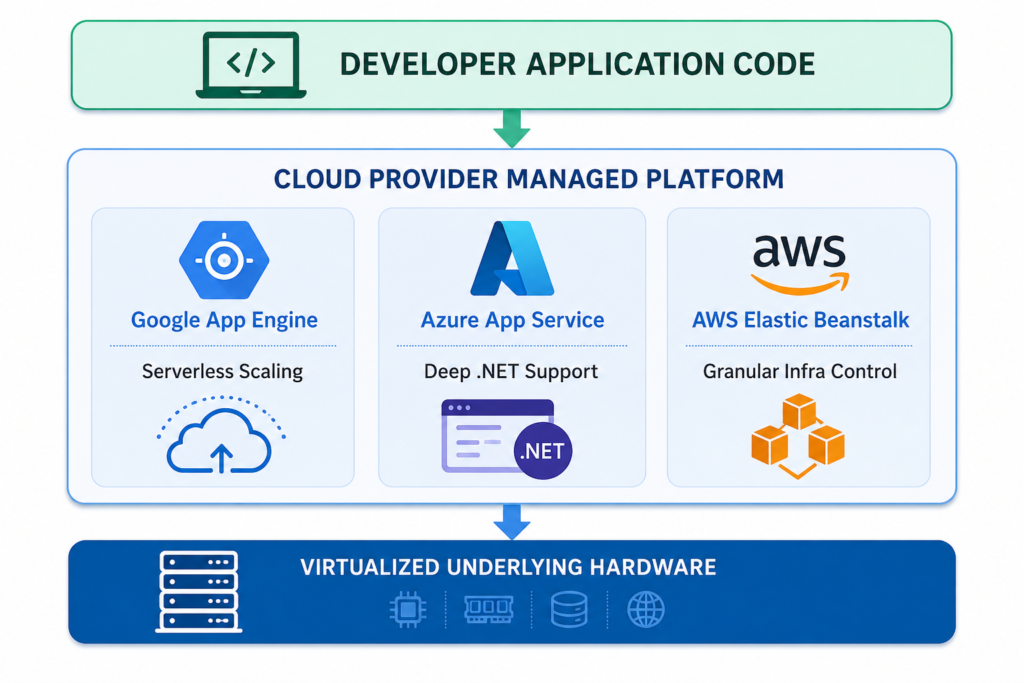
As a pioneer in the serverless platform space, Google App Engine allows engineering teams to host applications on the same global infrastructure that powers Google’s primary consumer services. The service abstracts away the underlying operating system and hardware entirely, scaling applications down to zero instances when traffic stops and scaling up instantly to handle immense traffic spikes.
It natively supports popular languages like Python, Java, Node.js, and Go, allowing developers to deploy code with a simple command line switch while the platform automatically configures load balancing, health monitoring, and data micro-storage.
Microsoft Azure App Service
This platform functions as an enterprise-grade service designed to build, deploy, and scale web applications and APIs within Microsoft’s cloud ecosystem. It provides deep, native integration with the Windows ecosystem, Visual Studio development tools, and standard .NET frameworks, making it a common choice for corporations migrating legacy internal applications to the cloud.
The service features comprehensive security access controls, isolated virtual network setups, and direct integration with active directory systems, ensuring applications comply with strict enterprise data protection rules.
AWS Elastic Beanstalk
Amazon Web Services approaches the platform model by prioritizing developer control over raw infrastructure. With Elastic Beanstalk, a developer uploads their application code using Java, .NET, PHP, Node.js, Python, Ruby, or Docker, and the platform automatically handles capacity provisioning, load balancing, auto-scaling, and application health monitoring.
Crucially, unlike alternative platforms that completely hide the underlying system, this service allows administrators to retain full root access to the underlying virtual servers. This gives teams the freedom to manually tweak specific operating system settings or adjust network routing configurations whenever necessary.
Heroku
Built as an independent, pioneer platform service before being acquired by Salesforce, Heroku gained widespread adoption by prioritizing developer experience and simplicity. It relies on a structural model where code repositories link directly to the platform, allowing developers to launch applications using a simple code push.
The ecosystem uses modular add-on components to let teams instantly attach managed databases, logging systems, and caching tools to their applications. This intuitive design makes it a favorite choice for startups, rapid prototyping teams, and agile software agencies.
Red Hat OpenShift
OpenShift operates as a specialized, enterprise-grade platform built entirely around container technology and Kubernetes orchestration. It can be deployed uniformly across public cloud data centers, private on-premises hardware, or edge computing locations, giving companies a consistent development environment regardless of the underlying infrastructure.
The system includes automated security patching, built-in system monitoring pipelines, and comprehensive access control frameworks. This structure makes it highly effective for large institutions that want the agility of a modern container platform combined with strict, enterprise-level security controls.
Vendor Lock-In: The Operational Risk Most Businesses Underestimate
While the speed and automation of platform services offer clear business advantages, relying on fully managed systems introduces a significant long-term strategic risk: vendor lock-in. When an engineering team builds an application inside a proprietary platform ecosystem, they often write code that depends directly on that specific provider’s built-in APIs, custom database connectors, and specialized configuration structures.
Over years of active development, this architectural dependency creates deep technical ties to a single cloud vendor. If that provider later increases their service pricing, shifts their corporate product roadmap, or suffers repeated data center outages, moving the application to a competing cloud network becomes an expensive and highly complex engineering challenge.
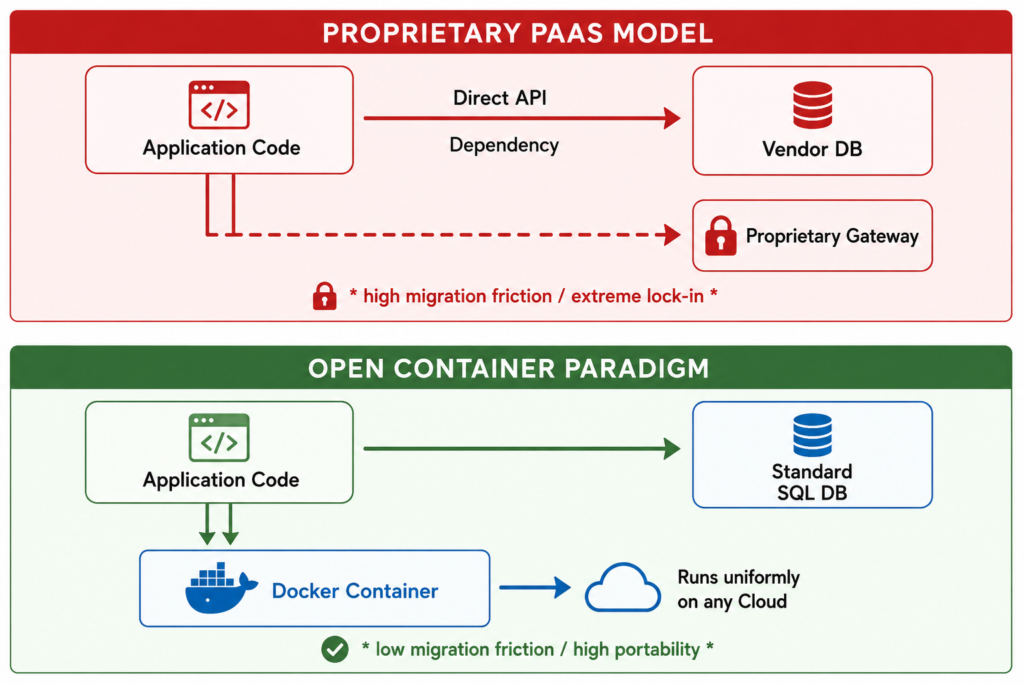
Avoiding this operational trap requires software architects to design for platform portability from day one. Engineering teams can minimize lock-in by using open-source database engines, building applications inside standardized container systems, and utilizing decoupled microservices that don’t rely on a vendor’s custom, proprietary APIs.
By building software around open, cloud-agnostic standards, a company preserves its long-term freedom to migrate workloads to alternative cloud networks or bring operations back to an on-premises data center if business priorities change.
Where PaaS Fits in Modern Enterprise Infrastructure
Platform as a Service has evolved from an optional development luxury into a core component of modern enterprise cloud strategy. By drawing a clear line at the application layer, it eliminates the operational drag of manual server provisioning, network configuration, and operating system patching. This architecture changes how modern businesses approach software delivery, turning raw infrastructure into an automated, programmatic utility.
Choosing the right cloud model requires matching your technical resources with your business goals. Organizations that need deep, low-level control over kernel settings and virtual networking will continue to rely on raw infrastructure services. Conversely, companies looking to deploy ready-made software directly to employees will opt for software subscriptions.
For teams focused on rapid software innovation, continuous feature updates, and efficient scaling, the platform layer delivers the ideal balance of velocity and control. As systems become more decentralized and data demands grow, PaaS remains the foundational environment that allows engineering teams to focus entirely on writing valuable code.
FAQ: PaaS in Cloud Computing
What is PaaS in cloud computing?
Platform as a Service is a cloud deployment model that delivers a fully managed runtime environment directly to software developers over the internet. The cloud provider takes complete responsibility for provisioning physical hardware, managing virtualization hypervisors, upgrading operating systems, and keeping middleware tools secure. This architecture allows software development teams to build, test, and launch custom applications without spending time or resources managing the underlying physical infrastructure.
What is platform as a service?
Platform as a service is an operational middle layer positioned between raw compute hardware and finished consumer software. It converts complex infrastructure assets into an automated, on-demand development platform. The service customer manages their custom application code and data schemas, while the platform vendor handles data center upkeep, hardware scaling, server maintenance, and system patching behind the scenes.
What are some PaaS examples in cloud computing?
Prominent enterprise examples include Google App Engine for fully automated, serverless web scaling, and Microsoft Azure App Service for applications integrated with the .NET framework. AWS Elastic Beanstalk provides a managed deployment environment that retains backend administrative root access, while Heroku focuses on simplified, developer-friendly git workflows. For containerized enterprise architectures, Red Hat OpenShift delivers a scalable platform built entirely around Kubernetes orchestration across hybrid clouds.
What is the difference between PaaS and SaaS?
The difference centers on the end-user and their level of technical control over the cloud asset. A platform service provides developers with an open runtime environment, development tools, and database frameworks to write, deploy, and manage custom application code. A software subscription delivers a fully completed product directly to end-business users through a web browser, leaving the customer with zero exposure to code repositories, database systems, or underlying infrastructure.
Is Kubernetes considered PaaS?
Standard Kubernetes is classified as a container orchestration tool rather than a traditional platform service. Raw Kubernetes requires engineering teams to manually configure network layers, manage storage volumes, handle ingress routing, and update cluster security baselines. However, when managed enterprise platforms like Red Hat OpenShift bundle Kubernetes into a fully automated environment with built-in development tools and automated patching, it functions effectively as an enterprise-grade container platform.
Why do enterprises use PaaS?
Enterprises adopt platform models to accelerate software delivery and reduce operational overhead. By eliminating the manual setup of servers, database connectors, and load balancers, development teams can transition code from testing to production in minutes instead of weeks. Additionally, the model converts unpredictable, upfront capital hardware expenses into elastic, pay-as-you-go operational fees that automatically adapt to real-time user traffic.
Is PaaS suitable for AI applications?
Yes, specialized AI platforms provide the ideal infrastructure for building and deploying machine learning models. These platforms give data science teams direct access to high-performance GPU arrays, pre-trained base models, and automated vector database integrations. This setup allows companies to build and run intelligent features like speech recognition or predictive analytics without needing to build a custom machine learning infrastructure from scratch.
What is vendor lock-in in PaaS?
Vendor lock-in is a strategic risk that occurs when an application is built using a cloud provider’s proprietary APIs, custom database setups, or specific configuration tools. Over time, the software becomes deeply dependent on that single vendor’s ecosystem. If the cloud provider later raises prices or experiences technical issues, migrating the codebase to a competitor becomes an expensive, time-consuming engineering project that requires rewriting significant portions of the application.