Selecting a commercial installation amplifier involves weighing far more than raw wattage ratings or channel counts. When my team and I design distributed audio layouts for corporate buildings or multi-zone hospitality venues, reliability, onboard digital signal processing flexibility, network management protocols, loudspeaker impedance compatibility, long-term serviceability, and ease of commissioning dictate whether a project succeeds or triggers constant service callbacks.
An amplifier must bridge the gap between architectural constraints and acoustic demands without introducing hums, latency, or configuration bottlenecks.
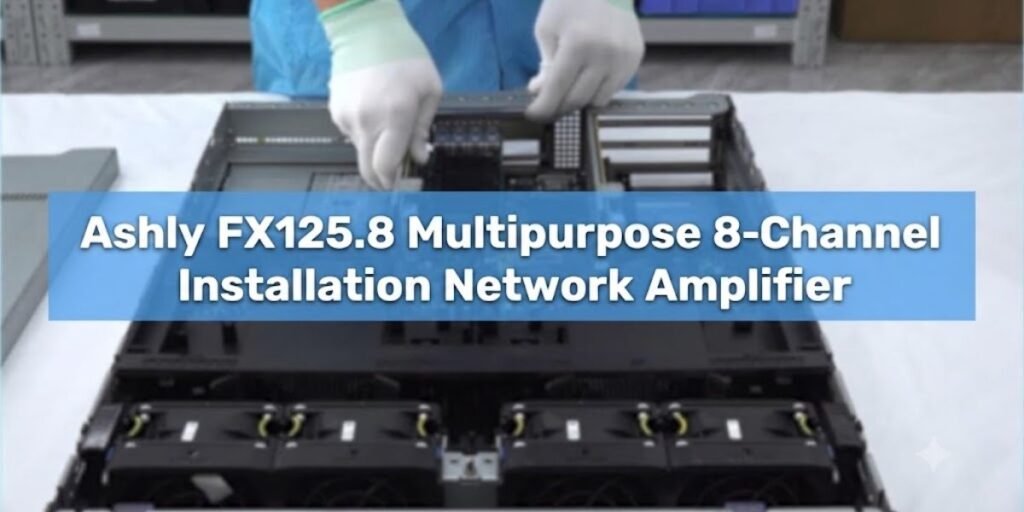
This guide evaluates where the Ashly FX125.8 multipurpose 8-channel installation network amplifier with DSP fits into modern commercial sound reinforcement, examining where it excels, where alternative hardware configurations might be necessary, and how its internal architecture handles complex multi-zone audio routing.
By the end of this deployment breakdown, you will understand its physical build quality, DSP capabilities, network control workflows, and total cost of ownership across various vertical markets.
Where the Ashly FX125.8 Fits in Today’s Commercial Audio Market
Commercial audio engineering has shifted away from massive, centralized analog power racks toward decentralized, network-managed multi-channel amplification platforms.
The Ashly FX125.8 occupies a strategic sweet spot within mid-sized commercial installations that demand clean, multichannel power coupled with sophisticated routing control.
Rather than serving touring concert rigs or large-scale outdoor sports stadiums requiring thousands of watts per channel, this amplifier is purpose-built for fixed installations where multiple independent zones require precise volume management, equalization, and paging priority.
In environments running continuous background music alongside emergency paging or multi-room conference audio, having eight discrete channels in a compact footprint simplifies rack design significantly.
Integrators working on commercial AV projects appreciate platforms that eliminate the need for outboard signal processors by baking comprehensive DSP toolsets directly into the amplifier chassis.
Projects Where the FX125.8 Makes The Most Sense
Deploying an eight-channel network amplifier requires aligning its power delivery and routing capabilities with the specific acoustic demands of a given venue type.
Corporate offices benefit immensely from this architecture, utilizing individual channels to drive ceiling speakers across private conference rooms, open collaboration zones, executive boardrooms, and common corridor paging systems.
Hospitality venues such as boutique hotels, upscale restaurants, and multi-room event spaces rely on the amplifier to balance distinct audio levels between ambient dining rooms, lively bar areas, and outdoor patio zones.
Educational facilities use the multi-channel layout to manage classroom audio reinforcement, hallway paging networks, and lecture hall distributed loudspeaker arrays.
Houses of worship find the DSP capabilities invaluable for maximizing speech intelligibility in reverberant sanctuaries while routing overflow audio to cry rooms and fellowship halls.
Healthcare environments, including medical clinics and hospital waiting areas, leverage robust paging priorities and background music zoning to maintain acoustic comfort and regulatory compliance.
Retail stores use the zoning flexibility to manage promotional audio levels near store entrances while keeping background music subtle in sales aisles.
Hardware Design That Matters During Installation
Physical engineering often dictates how smoothly an installation goes when technicians are working inside a cramped communications rack late at night.
The FX125.8 features a compact mechanical layout that maximizes thermal efficiency without demanding excessive vertical rack spacing.
The chassis incorporates variable-speed forced-air cooling that draws air from front to back, preventing thermal throttling during continuous full-day operation under demanding loads.
Terminal block connectors provide secure, positive-locking wire terminations for speaker outputs and auxiliary control lines, preventing loose connections caused by building vibrations or accidental cable tugs.
Clear channel labeling on both the front and rear panels allows technicians to verify signal flow instantly during troubleshooting sessions without cross-referencing digital wiring diagrams.
Serviceability is enhanced by accessible internal modular components and robust power supply design that handles fluctuating commercial AC line voltages gracefully.
DSP Features That Solve Real Installation Problems
Outboard signal processing adds cost and complexity to a rack, which is why integrated DSP engines must solve real-world acoustic challenges natively.
Balancing different speaker zones with varying sensitivity ratings becomes straightforward when individual channel gain staging and parametric equalization can be adjusted via software.
Protecting delicate ceiling loudspeakers from low-frequency overload is managed using configurable high-pass filters and precise peak-limiting algorithms.
Improving speech clarity in reverberant rooms is achieved by deploying multi-stage parametric filters to notch out problematic resonant frequencies.
Managing acoustic arrival times across large open architectural spaces requires precise channel delay adjustments to maintain sound synchronization.
Equalizing difficult architectural rooms with glass walls and hard concrete surfaces is simplified by utilizing onboard dynamic equalization and crossover filters that tailor frequency response dynamically.
Network Control and Remote Management
Modern commercial installations require robust IP-based control to minimize truck rolls and allow remote maintenance by system integrators.
The FX125.8 integrates Ethernet-based management protocols that allow technicians to monitor amplifier health, check internal temperatures, verify output voltages, and adjust routing parameters remotely.
Configuration workflows are streamlined through intuitive software interfaces that communicate seamlessly across segmented corporate networks and VLANs.
Firmware updates can be deployed across multiple units simultaneously, ensuring system security and feature parity without requiring physical USB connections to each amplifier.
Real-time diagnostics report impedance anomalies, clipping events, and thermal warnings before they cause unexpected hardware failures.
This level of remote visibility drastically reduces service calls, allowing integrators to troubleshoot minor configuration adjustments or monitor system status from an off-site Network Operations Center.
Designing Multi-Zone Audio with the FX125.8
Managing eight independent channels opens up sophisticated routing possibilities for complex commercial facilities.
Independent zone control allows an operator to send a localized microphone input to a specific conference room while streaming independent background music through hallway and lobby speakers.
Paging priorities can be programmed so that emergency or high-priority announcements override background music smoothly across all or selected zones using configurable ducking parameters.
Flexible output routing enables summing stereo inputs to mono for distributed ceiling speaker layouts where stereo separation is lost across large physical distances.
Volume management rules prevent unauthorized staff from driving amplifiers into distortion by setting hard output ceilings on individual zone attenuators.
Expansion planning is simplified because additional network-enabled amplifiers can be linked via IP switches to scale zone counts seamlessly as a building expands.
Loudspeaker Pairing Considerations
Matching an amplifier’s output architecture correctly to your selected loudspeakers determines whether a sound system operates efficiently or suffers from constant distortion and thermal stress.
Low-impedance installations require careful calculation of parallel and series wiring configurations to ensure the amplifier sees a safe load impedance matching its rated capabilities.
When configuring distributed systems, understanding transformer tap settings on ceiling and pendant speakers prevents overloading individual channels while ensuring even sound pressure distribution across long hallways or open spaces.
Surface-mount loudspeakers placed in outdoor or semi-exposed environments demand careful consideration of weather-resistant transformer taps and power handling limits.
Subwoofer integration can be handled by bridging channels or utilizing dedicated crossover routing within the DSP engine to send low-frequency energy exclusively to auxiliary low-frequency drivers.
Properly pairing these components ensures long-term operational stability and prevents premature amplifier protection shutdowns.
System Integration Beyond the Amplifier
An installation amplifier never operates in a vacuum; it acts as the power core within a wider ecosystem of commercial AV hardware.
Digital signal processors handle complex matrix mixing and acoustic echo cancellation before audio reaches the amplification stage.
Wall-mounted control panels and touchscreens allow end-users to select audio sources and adjust local zone volumes without accessing the main equipment rack.
Paging microphone stations interface via network protocols or analog contact closures to trigger priority announcements across designated zones.
Network switches must support Quality of Service configurations to prioritize audio data packets over general IT traffic in converged enterprise networks.
Emergency communication systems integrate via mute contacts or logic triggers to silence entertainment audio during fire alarms or security alerts.
Reliability in Long-Term Commercial Operation
Commercial clients measure audio system value by uptime, expecting equipment to run continuously for years without administrative intervention.
Thermal management inside the FX125.8 is engineered to dissipate heat efficiently during 24/7/365 operation in unventilated or warm equipment closets.
Continuous operation testing proves that internal power supplies and output stages maintain stable rail voltages even when subjected to heavy dynamic transients and varying AC line conditions.
Smart fan behavior ensures that cooling fans remain idle or spin at whisper-quiet speeds during low-level background music playback, ramping up only when high-power thermal loads demand increased airflow.
Built-in protection circuits guard against short circuits, DC offset, thermal overload, and over-current conditions, engaging automatic recovery once fault conditions clear.
Manufacturer support and stable firmware lifecycles ensure that integrators can maintain and service installed systems long after initial project handover.
Power Planning and Rack Design
Proper infrastructure planning prevents electrical tripping, excessive heat buildup, and premature hardware wear within the equipment rack.
Rack space allocation must account for ventilation gaps above and below the amplifier to ensure unrestricted airflow through the chassis intake and exhaust vents.
Heat dissipation calculations help technicians determine total BTU output, ensuring air-conditioned server rooms or dedicated AV closets remain within safe operating temperature ranges.
Electrical circuit planning requires verifying that the total current draw of multiple amplifiers does not overload dedicated branch circuits, especially when driving heavy low-impedance loads.
Uninterruptible Power Supply considerations are vital for life-safety paging systems, ensuring amplifiers remain operational during brief commercial power outages.
Professional cable management utilizing laced wire bundles and strain relief prevents physical tension on audio and network connectors.
Cost Beyond the Purchase Price
Evaluating commercial audio hardware solely on sticker price ignores the hidden operational expenses that accumulate over a system’s lifecycle.
Installation labor costs drop significantly when an amplifier features intuitive software commissioning, robust physical terminal blocks, and reliable network auto-discovery tools.
DSP commissioning time is reduced when built-in processing tools eliminate the need to wire, program, and troubleshoot external hardware signal processors.
Network setup efficiency lowers IT overhead during deployment and simplifies long-term remote maintenance routines.
Future scalability is preserved when multi-zone routing can be reconfigured via software rather than physically rewiring equipment racks.
Energy consumption remains optimized through efficient class-D power topology and intelligent standby modes, reducing utility overhead for commercial facility managers.
Current Pricing and Market Availability
Procuring commercial AV hardware involves navigating regional distribution networks rather than retail e-commerce channels.
The Ashly FX125.8 positions itself in the professional mid-tier pricing bracket relative to competing commercial installation amplifiers, reflecting its build quality, robust DSP engine, and multi-channel density.
Pricing varies significantly based on regional distributors, project scale, and commercial integrator procurement agreements.
Professionals typically source these units through authorized commercial AV distributors, certified systems integrators, or direct enterprise procurement channels.
Factors influencing final project pricing include channel configuration requirements, specialized control accessories, extended warranty packages, and custom software programming agreements.
How It Compares with Similar Installation Amplifiers
Comparing the FX125.8 against competing multi-channel platforms from manufacturers like QSC, Crown, Yamaha, Biamp, and AtlasIED highlights distinct engineering priorities.
While QSC and Biamp systems often rely heavily on proprietary audio-over-IP networking ecosystems for large-scale distributed routing, Ashly focuses on delivering robust standalone DSP and local multi-channel flexibility in a cost-effective package.
Compared to traditional contractor amplifiers from Crown or Yamaha, the integrated DSP toolset in the Ashly platform offers deeper equalization and routing control without requiring external matrix processors.
Integrators often choose the FX125.8 when a project demands eight discrete channels of reliable power with onboard processing but does not justify the added complexity and licensing costs of massive enterprise networked audio fabrics.
Situations Where We Would Choose the FX125.8
Certain project profiles align perfectly with the engineering strengths of this eight-channel platform.
Corporate campuses requiring multi-room conference audio routing and synchronized floor-by-floor paging benefit from its channel density and reliable DSP management.
Hotels managing distinct audio zones across lobbies, restaurants, and conference centers utilize its flexible matrix routing to keep multiple spaces running independently.
Educational facilities upgrading older analog paging and classroom reinforcement systems find the network control and multi-zone output structure ideal for modern campus standards.
Conference centers needing reliable speech intelligibility processing across flexible partition walls rely on its parametric EQ and delay management.
Retail chains standardizing on a compact, reliable rack footprint for background music distribution choose it to minimize equipment clutter.
Situations Where We’d Recommend Something Else
Recognizing the technical boundaries of an amplifier prevents costly deployment mistakes on demanding projects.
For massive sports stadiums or outdoor concert arenas requiring thousands of continuous watts per channel over long cable runs, high-power touring amplifiers are necessary.
For large-scale campus networks requiring hundreds of channels distributed across fiber-optic backbones using Dante or AVB transport protocols, dedicated networked audio distribution platforms are better suited.
For simple single-zone background music systems in small retail shops, a compact two-channel commercial mixer-amplifier provides a more cost-effective solution.
Projects requiring specialized proprietary control ecosystems tied exclusively to specific automation brands may necessitate choosing an amplifier native to that manufacturer’s ecosystem.
What Stands Out After Working with the FX125.8
Hands-on deployment and configuration reveal several practical advantages that impact daily engineering workflows.
The installation experience is remarkably smooth due to clean rear-panel layouts, secure terminal blocks, and reliable network discovery tools.
DSP flexibility eliminates the headache of patching external hardware processors, keeping signal paths clean and configuration centralized.
Network management tools provide dependable remote monitoring capabilities that give integrators peace of mind after project sign-off.
Build quality inspires confidence, handling continuous daily operation without thermal faulting or unexpected crashes.
Expandability and ease of maintenance make it a reliable cornerstone for commercial integrators managing diverse facility portfolios.
Final Verdict
When planning a commercial audio installation that requires multi-zone routing, robust DSP, and reliable multi-channel power, the Ashly FX125.8 represents a sound, long-term investment.
If I were specifying an amplifier for a multi-zone corporate office or hospitality venue today, I would deploy this unit with full confidence because its balance of hardware density and internal processing power simplifies system design significantly.
While massive stadium projects and large-scale networked audio fabrics require heavier infrastructure, the FX125.8 hits an optimal sweet spot for mid-sized commercial installations where reliability and acoustic control matter most.
Frequently Asked Questions
Is the FX125.8 suitable for 24/7 operation?
Yes, the amplifier is engineered with heavy-duty thermal management and robust power supply topologies designed for continuous, uninterrupted commercial operation.
Can it power multiple speaker zones independently?
Yes, the eight independent channels allow integrators to assign unique audio sources, volume levels, and equalization settings to distinct zones across a facility.
Does it integrate with existing commercial AV systems?
Yes, it accepts standard analog audio inputs and offers flexible control integration options to interface seamlessly with third-party control systems and matrix switchers.
Is professional DSP tuning required?
While basic setup can be achieved out of the box, professional acoustic tuning utilizing measurement software is recommended to optimize equalization and filtering for specific room acoustics.
What types of loudspeakers work best with it?
It pairs effectively with standard low-impedance commercial loudspeakers and distributed speaker setups when wired and configured within its rated power limits.
How scalable is the platform?
The platform scales easily by integrating additional network-enabled amplifiers across an IP switch infrastructure to accommodate larger facility expansions.
Is it appropriate for hospitality or educational environments?
Yes, its multi-zone routing, paging priority handling, and speech intelligibility features make it well-suited for both hospitality venues and educational facilities.
What should be considered before specifying it in a new project?
Integrators should evaluate total channel count requirements, speaker impedance loads, control network infrastructure, and acoustic processing needs before finalizing project specifications.