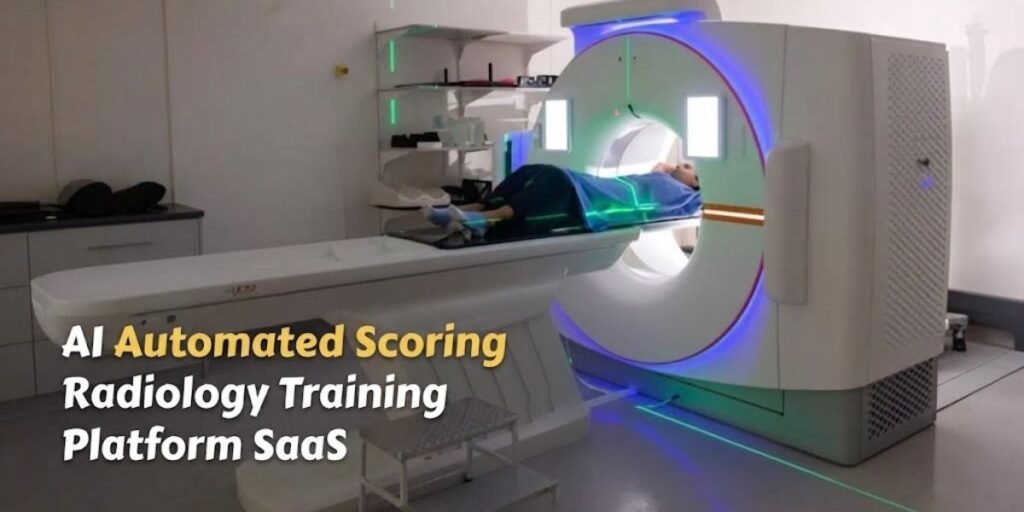
Radiology education has long depended on a traditional master-apprentice model combining clinical case exposure, supervised reporting, structured board review courses, and ad-hoc verbal feedback from attending radiologists. While this model remains foundational, it faces a severe structural bottleneck: the exponential growth of imaging volumes outpaces available faculty teaching hours. A resident rotating through a busy academic medical center might interpret dozens of cross-sectional studies during an on-call shift, yet receive detailed, individualized faculty critique on only a tiny fraction of those cases.
To bridge this supervision gap, medical institutions and educational software developers are deploying AI-powered SaaS training platforms equipped with automated assessment engines. These solutions move far beyond static case libraries and multiple-choice question banks. Modern platforms simulate interactive DICOM reading environments, evaluate spatial localization coordinates, parse free-text radiology reports using advanced natural language processing, and generate immediate formative feedback.
However, confusion persists because the term automated assessment is not standardized across the industry. Some software modules score binary diagnostic choices, others grade free-text structured reporting against reference standards, and some simulate oral board examinations. Recognizing these technical boundaries is essential for residency program directors and trainees evaluating digital learning tools.
Why AI Radiology Education Platform Adoption Is Accelerating
The accelerating shift toward AI-assisted radiology training is driven by distinct operational pressures inside modern healthcare systems. Hospital networks face surging imaging backlogs, forcing departments to maximize efficiency without compromising diagnostic accuracy. For trainees, encountering a balanced cross-section of rare pathologies and complex modalities during routine clinical rotations is largely a matter of chance rather than design.
Deliberate practice requires structured repetition and immediate error correction – conditions that traditional clinical workflows rarely accommodate. Faculty members juggling heavy clinical loads, administrative duties, and patient care obligations naturally struggle to provide consistent, real-time reviews of every resident preliminary report.
Clinical research underscores both the necessity and the capability of automated evaluation tools. A landmark study published in the American Journal of Roentgenology demonstrated that large language models utilizing static few-shot prompting could detect and classify critical findings in radiology reports with 90.1% precision and 86.9% recall on holdout test sets. Furthermore, a 2026 study published in Nature: Scientific Reports revealed that advanced multimodal models like GPT-4o generated follow-up imaging recommendations with overall global quality comparable to board-certified radiologists and superior to junior residents.
Adoption is ultimately governed by four undeniable realities:
- exploding imaging volumes that restrict direct faculty observation time
- the necessity for deliberate practice across rare disease manifestations
- limited expert feedback capacity within busy hospital departments
- the proven capability of modern AI models to accurately analyze complex radiological reports and spatial inputs
What “Automated Assessment” Means In These SaaS Education Platforms
Image Interpretation Scoring
Basic automated platforms evaluate whether a trainee arrived at the correct overarching diagnosis or recognized a primary abnormality. While useful for screening core knowledge, a simple binary correct-or-incorrect score fails to measure comprehensive diagnostic reasoning or perceptual search patterns.
Finding Localization Assessment
Localization scoring evaluates whether a learner pinpointed the exact anatomical coordinates of an abnormality within an image matrix. Recognizing that a chest radiograph contains a subtle pneumothorax is clinically distinct from correctly outlining its boundaries. Platforms like RadGame utilize intersection-over-union algorithms to compare learner-drawn bounding boxes directly against expert radiologist annotations from public datasets.
Report Assessment and Natural Language Grading
Advanced platforms evaluate unstructured, free-text radiology reports rather than relying solely on multiple-choice questions. These systems check for omitted critical findings, descriptive errors, logical contradictions, and improper terminology use. Utilizing specialized metrics derived from models like GPT-o3 or fine-tuned transformers, automated report engines isolate specific reporting discrepancies and generate granular style and accuracy scores.
Diagnostic Performance Analytics
Platforms designed around quantitative metrics track longitudinal sensitivity, specificity, positive predictive values, and receiver operating characteristic curves. DetectedX exemplifies this model by benchmarking learner decisions directly against pathology-confirmed ground truth cases.
Formative AI-Generated Feedback
Assessment and feedback serve entirely different pedagogical functions. A score assigns a numerical value to performance, whereas AI feedback explains the underlying cognitive or perceptual failure. By integrating vision-language models, modern platforms provide contextual explanations that guide learners toward correct diagnostic pathways without simply giving away the answer.
Examination Simulation Scoring
Board-prep platforms simulate timed written and oral examinations, scoring structured responses against standardized marking rubrics. However, institutional leaders must treat these platform scores as formative coaching indicators rather than guaranteed predictors of official board certification outcomes.
The 5 Best AI-Powered Radiology Education Platforms With Automated Assessment Features
1. RadBytes
RadBytes operates as an interactive SaaS-based radiology education and case-interpretation environment tailored for residents, fellows, and practicing clinicians looking to sharpen diagnostic competency. Developed to bridge the gap between static textbook learning and live clinical reporting, the platform delivers digital case studies via a high-performance, DICOM-compliant web viewer. Users can manipulate window and level presets, pan, zoom, and scroll through multi-slice volumetric datasets across computed tomography, magnetic resonance imaging, and radiography.
Core features include multi-modality case libraries, interactive image manipulation tools, the conversational AI tutor Cubey, automated scoring engines, and longitudinal resident performance tracking.
The defining technological asset within RadBytes is its conversational AI tutoring assistant, frequently designated as Cubey. Unlike passive answer keys, Cubey engages learners in real-time dialog during case review. If a trainee struggles to identify a subtle interstitial pattern or overlooks a focal liver lesion, the AI prompts them with targeted Socratic questions, highlights relevant anatomical zones, and encourages structured differential diagnosis formulation without spoiling the final pathology.
Once the case is completed, the platform evaluates the user’s structured report or diagnostic dropdown selections against expert reference standards. Automated scoring algorithms instantly calculate diagnostic accuracy, while longitudinal analytics dashboards track performance trends across specific subspecialties, modalities, and difficulty tiers.
Pricing and access options feature individual monthly plans starting around $97 per month, providing self-paced access to core case modules and AI tutoring interactions. Enterprise institutional packages are customized for residency programs, delivering dedicated administrative dashboards, custom case upload utilities, and bulk cohort performance tracking.
2. M3 Academy
M3 Academy functions as a rigorous, examination-focused SaaS education platform engineered specifically for postgraduate radiology trainees preparing for high-stakes board certifications and rapid-reporting clinical milestones. Established to mirror the high-pressure environment of professional licensing exams, the platform provides an extensive library of curated short and long clinical cases.
Core features include timed short-case modules, rapid-reporting workflows, automated instant scoring against standardized criteria, and personalized resident remediation paths.
The platform’s pedagogical engine revolves around timed diagnostic sessions and rapid structured reporting modules. Trainees examine high-resolution imaging studies, synthesize findings under strict time constraints, and input their impressions into an interface modeled after commercial Picture Archiving and Communication Systems (PACS).
M3 Academy utilizes immediate AI-powered scoring mechanisms designed to evaluate submissions against standardized radiological criteria. The system assigns automated percentage scores, highlights descriptive omissions, and delivers immediate personalized remediation paths. While its automated marking engine provides rapid feedback loops, program directors should pair its output with periodic faculty reviews to ensure alignment with local institutional standards.
Pricing and access options include a month-to-month individual plan priced at $97.00 per month, a three-month plan at $82.45 per month ($247.35 total, saving 15%), and a six-month comprehensive plan at $67.90 per month ($407.40 total, saving 30%). Institutional tier licenses cater to academic departments requiring cohort analytics and residency performance tracking.
3. RadGame
RadGame represents an academically backed, AI-powered gamified platform specifically engineered to address the limitations of traditional radiology training by targeting two fundamental competencies: localizing subtle imaging findings and generating precise clinical reports. Documented extensively in machine learning research proceedings, RadGame bridges rigorous medical AI research with practical educational design.
Core features include spatial bounding box annotation tasks, intersection-over-union coordinate scoring, free-text report analysis using transformer models, and real-time visual explanations powered by vision-language architectures like MedGemma 4B.
The platform operates through two distinct pedagogical modules: RadGame Localize and RadGame Report. In RadGame Localize, trainees view single frontal chest radiographs sourced from large-scale public datasets like PadChest-GR and are challenged to draw precise bounding boxes around focal abnormalities or select diffuse pathological findings. The system automatically compares learner coordinates against radiologist-drawn ground-truth annotations using an Intersection-over-Union threshold of 0.25. When findings are missed, vision-language models generate targeted visual explanations.
In RadGame Report, trainees compose complete findings sections based on multi-image studies, patient age, and clinical indications. Submissions are evaluated using advanced language models like GPT-o3 that filter out normal findings, weigh clinical severity based on patient context, and calculate a comprehensive CRIMSON score (0-100%) alongside a separate Style Score assessing reporting best practices.
In prospective, multi-institutional user studies involving medical trainees, participants utilizing RadGame achieved a 68% improvement in localization accuracy compared to 17% in traditional passive control groups, and a 31% improvement in report-writing accuracy compared to 4.3% in control groups after reviewing identical cases.
Pricing and access options are structured primarily through academic research partnerships, medical school framework agreements, and custom enterprise integrations for residency programs seeking validated assessment tooling.
4. SmashRadiology
SmashRadiology operates as a specialized, examination-oriented training ecosystem built to support residents and fellows preparing for oral vivas, practical board exams, and high-stakes clinical competency evaluations.
Core features include timed oral board simulations, rapid-fire case interpretation drills, structured text response evaluation, and instant performance grading.
The platform emphasizes timed case interpretation, structured oral examination simulation, and rapid automated scoring. Trainees navigate through rapid-fire case sequences designed to test quick decision-making, differential diagnosis prioritization, and concise verbal or written communication under stress.
The underlying AI evaluation engine analyzes structured text inputs and diagnostic selections, comparing them against verified expert benchmarks to generate instant performance grades. While SmashRadiology provides highly effective formative feedback for examination conditioning, its scores should be viewed as coaching metrics rather than definitive predictors of official board passage.
Pricing and access options are tailored through individual subscription tiers targeting residents entering critical board review windows, with flexible month-to-month and exam-cycle durations.
5. DetectedX
DetectedX stands apart from conversational LLM platforms by focusing heavily on self-assessment, pathology-confirmed ground truth, and longitudinal diagnostic performance measurement across multiple imaging modalities, including mammography, ultrasound, computed tomography, and magnetic resonance imaging.
Core features include pathology-verified real-world case archives, immediate diagnostic performance calculation, longitudinal sensitivity and specificity tracking, institutional analytics dashboards, and accredited Continuing Medical Education (CME/CPD) modules.
The platform provides clinical cases backed by definitive tissue pathology or expert consensus panels. Trainees interact with real-world imaging datasets to locate abnormalities, render diagnoses, and receive instant scoring.
DetectedX calculates exact diagnostic performance indicators, including sensitivity, specificity, and accuracy metrics. Its institutional model powers comprehensive departmental dashboards, Continuing Medical Education tracking, and cohort performance benchmarking. Rather than grading free-text paragraphs, DetectedX measures structured diagnostic decisions against hard clinical data, making it a gold standard for objective competency verification.
Pricing and access options include a 7-day free trial, followed by flexible monthly and discounted annual unlimited access subscriptions for individual practitioners. Institutional agreements are available via direct enterprise inquiry for hospital networks and university medical departments seeking multi-seat deployment and curriculum integration.
How These AI Education Platforms Can Improve The Way Radiologists Learn
The integration of automated assessment fundamentally transforms the educational feedback loop in medical training. Traditional case reviews rely on a static, linear structure: a resident reviews a case, checks an answer key at the back of a textbook or module, and moves on without deeper analytical reflection.
AI-assisted SaaS platforms replace this static model with a dynamic, cyclical workflow:
- review an interactive DICOM case
- submit structured diagnostic findings or a formal report
- receive immediate automated scoring and spatial comparison
- analyze context-aware AI explanations for missed findings
- execute targeted remedial practice on similar case variations
This architecture drives genuine deliberate practice. Trainees no longer wait weeks for an overburdened attending to review an archived report. Errors are flagged within seconds, preventing the reinforcement of faulty visual search patterns or incorrect terminology.
Furthermore, reporting practice improves dramatically. Because modern natural language processing engines evaluate free-text impressions against clinical reference standards, trainees learn to eliminate vague phrasing, structure their observations logically, and ensure all incidental findings are documented.
Ultimately, these platforms maximize the value of limited faculty time by automating routine grading and preliminary error identification, allowing human mentors to focus on complex clinical reasoning, ethical decision-making, and professional mentorship.
How Reliable Is The Scoring These Radiology Training Platforms Provide?
Evaluating the reliability of AI-generated radiology training scores requires critical appraisal. Automated scoring is not a monolithic measurement; its trustworthiness depends entirely on the task being evaluated, the quality of the reference standard, and the depth of platform validation.
| Scoring Modality | Evaluation Mechanism | Reliability & Validation Level | Primary Pedagogical Use |
| Finding Localization | Spatial coordinate comparison against expert bounding boxes (IoU metrics) | High. Relies on mathematical spatial overlap with clear ground truth. | Training visual search patterns and perceptual accuracy. |
| Diagnostic Classification | Multiple-choice or structured dropdown matching against pathology-verified keys | High. Deterministic matching against established clinical diagnoses. | Core knowledge acquisition and screening. |
| Report Assessment | Natural language processing evaluating text against reference reports | Moderate to High. Proven high precision in detecting critical errors, though phrasing variations require sophisticated parsing. | Improving structured reporting and communication clarity. |
| Exam Simulation Scoring | Rubric-based scoring of timed diagnostic responses | Moderate. Excellent for formative practice, but unproven as a predictor of board success. | Board preparation and time management training. |
Clinical data confirms that while AI models show remarkable agreement with attending consensus for specific reporting errors, human readers themselves exhibit natural variation in how they grade subjective text. AI training scores are exceptionally powerful tools for formative education and daily self-assessment, but they are not yet validated for high-stakes credentialing or independent graduation decisions.
What Features Should Institutes Consider Before Choosing An AI Radiology Education Platform?
Educational Content
Institutions must audit the depth, breadth, and quality of the underlying case library. Platforms must support realistic DICOM viewing tools, diverse modalities, rare and common pathologies, variable difficulty levels, and comprehensive clinical histories rather than static low-resolution image files.
Assessment Methodology
Program directors need absolute transparency into what the platform measures. Does it evaluate binary diagnoses, spatial localization coordinates, report quality, or timed board simulations? Understanding the underlying reference standard is crucial for verifying educational validity.
AI Transparency
Vendors must clearly articulate where artificial intelligence is utilized, what data evaluates learner submissions, how feedback is generated, and what independent peer-reviewed studies support their scoring algorithms.
Learning Management Capabilities
Platforms require robust administrative features, including individual learner accounts, automated assignment distribution, detailed progress tracking, historical performance logging, and cohort management tools.
Faculty Dashboards and Oversight
Residency programs require more than student-facing portals. Effective platforms provide faculty dashboards, aggregate cohort analytics, assignment creation tools, and automated flagging systems to identify struggling residents who require immediate faculty intervention.
Technical Deployment and Security
Institutional buyers must evaluate cloud architecture, single sign-on SSO authentication, DICOM data handling, enterprise security standards, data privacy compliance including HIPAA and GDPR, and IT integration requirements.
Commercial Licensing and Support
Decision-makers must review licensing structures, per-seat pricing versus enterprise site licenses, administrator onboarding support, customer success availability, data ownership clauses, and contract renewal terms.
Frequently Asked Questions
What Is An AI Radiology Education Platform?
An AI radiology education platform is specialized software designed to train medical students, residents, and practicing radiologists using interactive digital cases paired with automated assessment, scoring, and AI tutoring.
What Does Automated Assessment Mean In Radiology Education?
Automated assessment refers to software algorithms that evaluate a learner’s image interpretations, diagnostic choices, spatial annotations, or written radiology reports against established reference standards without requiring manual faculty grading.
What Can AI Actually Score In Radiology Training?
AI can score multiple-choice diagnostic selections, precise anatomical localization coordinates, specific reporting errors, structural completeness, and overall diagnostic accuracy metrics like sensitivity and specificity.
Can AI Assess A Radiology Report?
Yes. Modern natural language processing models can parse free-text radiology reports to identify omitted findings, incorrect terminology, diagnostic inconsistencies, and descriptive errors by comparing them against reference gold standards.
How Reliable Are AI-Generated Radiology Training Scores?
AI training scores are highly reliable for formative feedback and daily deliberate practice, but they should be treated as coaching tools rather than validated metrics for high-stakes competency evaluations.
Which Radiology Education Platforms Offer Automated Scoring?
Platforms such as RadBytes, M3 Academy, RadGame, SmashRadiology, and DetectedX incorporate various forms of automated scoring, immediate feedback, or performance analytics.
Can AI Radiology Education Platforms Replace Faculty Feedback?
No. AI platforms supplement faculty teaching by handling repetitive scoring and preliminary error detection, allowing human mentors to focus on complex clinical reasoning, professional mentorship, and nuanced decision-making.
Are AI Training Scores Equivalent To Official Radiology Examination Scores?
No. Platform-generated training scores reflect formative performance within a specific software environment and do not predict formal outcomes on official board certification examinations.
Can Radiology Residency Programs Use AI Education Platforms?
Yes. Residency programs use these platforms to supplement clinical rotations, assign targeted practice cases, track cohort progress, and identify residents who need additional supervision.
What Should An Institution Check Before Choosing An AI Radiology Education Platform?
Institutions should evaluate content quality, assessment methodology, AI transparency, faculty analytics dashboards, technical security, integration requirements, and commercial licensing terms before making a purchasing decision.