Quality assurance in Software as a Service (SaaS) is not a final checkpoint. It is a continuous engineering process embedded into every stage of development. Unlike traditional on-premise applications, cloud-native platforms operate in an always-on, multi-tenant state. Here, updates, database migrations, and concurrent user activities happen in real time. This environment makes SaaS testing a critical baseline for engineering reliability, performance stability, and user retention.
Data from recent enterprise software research indicates that engineering defects in cloud environments cost businesses substantial capital due to immediate churn, API failures, and service-level agreement (SLA) violations. When a bug bypasses development gates, it impacts thousands of business tenants simultaneously, creating widespread operational disruption.
This technical guide covers how modern QA engineering operates inside complex web architectures, the deep architectural differences that dictate modern test design, and the automated pipeline frameworks required to validate multi-tenant systems at scale.
What Is SaaS Testing and Quality Assurance (QA)?
To understand quality control in a cloud-first landscape, engineers must separate basic functional user-interface validation from systemic system verification.
What is SaaS Testing?
SaaS testing is the specialized process of validating a cloud-hosted application to ensure it executes reliably across web transport layers, isolated databases, distributed API networks, and variable browser configurations. It ensures the software functions correctly across multiple users at the exact same time (multi-tenancy), different browsers and mobile devices, cloud hosting infrastructures like AWS, Azure, or GCP, and continuous deployment execution tracks.
What is QA in SaaS?
Quality Assurance (QA) in SaaS development is a structured engineering discipline focused on preventing bugs before production, validating system behavior under real-world conditions, ensuring performance, security, and scalability, and maintaining reliability during frequent updates.
In traditional software deployment loops, testing operated as a final gateway prior to physical packaging. Inside a web application environment, QA transforms into a continuous validation loop. It integrates directly into the continuous integration and continuous deployment (CI/CD) pipeline, meaning every code commit triggers instant, multi-layered quality checks.
Why SaaS Testing Is Different From Traditional Software Testing
SaaS applications behave differently from traditional desktop or localized enterprise software due to their underlying cloud architecture. If a QA team attempts to apply classic, static validation schedules to a multi-tenant platform, the deployment pipeline will collapse under the weight of release delays and missed system breakages.
Testing cloud applications requires an entirely different technical approach due to specific operational realities:
Continuous Deployment Pipelines
Traditional software operates on quarterly, bi-annual, or annual patch release cycles. Modern web applications utilize automated pipelines to ship code changes weekly, daily, or multiple times per day. The testing apparatus must execute deterministically within minutes to avoid blocking the release train.
Multi-Tenant Architecture Execution
On-premise deployments isolate a single software instance for a single client. In a multi-tenant layout, a single core application build, web server pool, and database cluster serve thousands of independent organizations simultaneously.
Testing must guarantee that one tenant’s heavy analytical calculations or bulk data imports do not degrade performance or leak private information to another tenant sharing the same cloud computing resource.
Deep Cloud and Third-Party API Dependencies
SaaS software rarely operates as a standalone package. It relies on a sprawling ecosystem of external APIs, federated single sign-on tools, credit card payment gateways, and elastic cloud microservices. Testing protocols must account for network latency, third-party service outages, and data schema updates that occur outside the company’s internal repository controls.
Real-Time, Uninterrupted Web Usage
When a desktop application crashes, the blast radius is isolated to a single employee workstation. When a core cloud application suffers an outage, every tenant worldwide loses operational capacity instantly. This makes system downtime immediately visible to the public market, elevating the importance of rigorous background performance validation.
SaaS Development Lifecycle and QA Integration
To maintain velocity without sacrificing platform stability, modern engineering groups employ a shift-left approach. This philosophy moves quality checks to the earliest phases of product design, catching logical flaws before developers type a single line of production code.
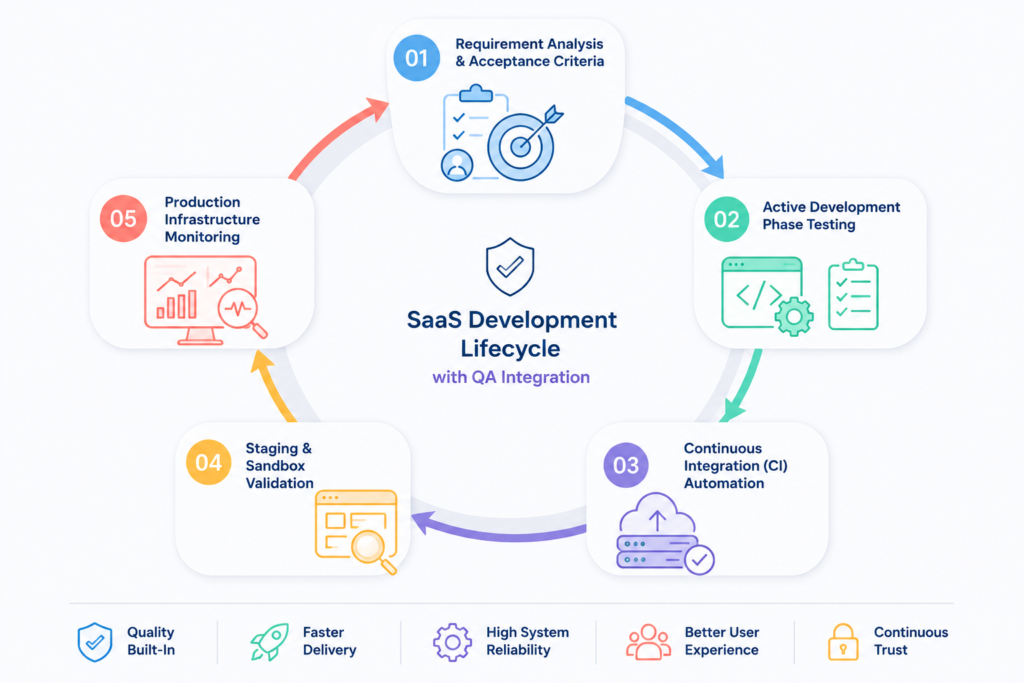
A resilient cloud QA framework distributes validation actions across distinct lifecycle gates:
1. Requirement Analysis and Acceptance Criteria
Quality engineers review product roadmaps alongside software architects before a development sprint begins. The team establishes concrete, testable acceptance criteria using structured frameworks like behavior-driven development (BDD). This step ensures the software goals match expected technical realities from day one.
2. Active Development Phase Testing
As features are actively built, developers write localized unit tests to validate specific code modules. QA leads review the new features for overall testability, building matching automated test hooks and mocking necessary third-party API payloads so the code module can be isolated and verified the moment it is committed.
3. Continuous Integration (CI) Automation
When a developer pushes code to the shared repository, a containerized build process initiates automatically. The CI server fires off the entire suite of unit and integration tests, blocking any code merge that triggers a test failure or introduces a regression.
4. Staging and Sandbox Validation
Merged builds deploy instantly to a dedicated staging environment that mirrors production data footprints, server capacities, and security parameters. Here, QA teams run complete end-to-end integration flows, checking user access structures, third-party application configurations, and cross-browser visual rendering.
5. Production Infrastructure Monitoring
The QA loop does not terminate once code goes live. Production monitoring tools track system error rates, database queries, and response times in real time. This gives engineering teams immediate visibility into production performance anomalies before users can file a formal support ticket.
Types of SaaS Testing
Validating a modern cloud platform requires deploying specialized testing strategies across different layers of the application stack. A comprehensive QA framework uses distinct methodologies to ensure that front-end features, back-end logic, and system infrastructure remain stable under heavy usage.
The following core testing methodologies are utilized by modern engineering teams to protect their application environments:
1. Functional Testing
Functional testing verifies that every core feature of the application executes exactly as specified in the product documentation. Engineers simulate diverse user interactions to test essential software flows, including customer onboarding steps, user registration portals, dashboard reporting filters, and multi-tier subscription payment funnels. These tests confirm that the business logic behaves predictably for different user personas.
2. API Testing
Modern web platforms rely heavily on internal and external application programming interfaces (APIs) to pass data packets between front-end interfaces and back-end database layers. API testing bypasses the graphic user interface entirely to validate endpoints, payload schemas, data formats like JSON or XML, and transport protocols.
Engineers test endpoints to verify response codes, validate data payload encryption, measure server response latencies, and check how the application handles malformed requests. Common tools utilized for this verification layer include Postman, SoapUI, and RestAssured.
3. Regression Testing
Because web applications receive frequent patch updates and feature additions, regression testing is a mandatory phase of the release cycle. This process involves executing a dedicated suite of automated tests against a newly compiled build to guarantee that recent changes have not broken existing, stable code modules.
Automating this process prevents older software bugs from resurfacing after a new deployment, making it an essential practice for continuous deployment models.
4. Performance, Load, and Stress Testing
Performance testing evaluates system stability, responsiveness, and infrastructure resource consumption under varying user traffic loads. Engineers run specialized simulations to verify how the platform handles specific operational thresholds:
- Load Testing: Simulates expected peak user traffic volumes to confirm the system maintains standard response times under normal busy conditions.
- Stress Testing: Pushes the application past its designed traffic limits to identify the exact point where database queues fail or servers crash.
- Scalability Testing: Verifies that cloud infrastructure automatically provisions additional virtual servers or database instances as traffic climbs.
To execute these high-volume traffic simulations, QA teams utilize load generation tools like Apache JMeter, Locust, and Gatling.
5. Security and Compliance Testing
SaaS applications serve as central repositories for sensitive corporate data, making them prime targets for malicious actors. Security testing systematically scans the application stack for vulnerabilities like injection flaws, cross-site scripting (XSS), broken object-level authentication, and insecure data encryption protocols.
Engineers utilize specialized security suites like OWASP ZAP and Burp Suite to run deep penetration scans, ensuring the software adheres to strict data privacy regulations like SOC 2, GDPR, and HIPAA.
6. User Interface (UI) and End-to-End (E2E) Testing
End-to-end testing replicates a complete, real-world user journey from initial login to final data export. These automated tests interact with the browser exactly like a human user, validating navigation menus, form field entries, button clicks, and cross-browser rendering accuracy across platforms like Chrome, Safari, and Firefox.
Modern development teams build these browser automation tracks using frameworks like Cypress, Selenium, and Playwright.
Tools Used in SaaS Testing Environments
To keep pace with modern release schedules, QA teams rely on an integrated toolchain that automates repetitive validation tasks and provides real-time system feedback.
The enterprise-grade toolset used across cloud testing architectures includes:
- Automation Frameworks: Playwright, Cypress, and Selenium serve as the core engines for driving web browsers and executing automated user flows.
- API Diagnostic Tools: Postman and RestAssured manage programmatic requests, handle automated authorization headers, and parse response schemas.
- Load Generation Infrastructure: Apache JMeter, Gatling, and Locust generate tens of thousands of concurrent virtual user connections to stress-test back-end systems.
- CI/CD Pipeline Orchestrators: Jenkins, GitHub Actions, and GitLab CI act as automation hubs, running the entire test suite every time code is changed.
- Observability and Monitoring Suites: Datadog, New Relic, and Sentry track live system health, trace API call paths, and log unhandled production errors instantly.
Real-World SaaS Testing Workflow
A resilient engineering pipeline processes every single code update through a structured automation sequence before it can reach production environments. This workflow prevents unverified changes from impacting live enterprise tenants.
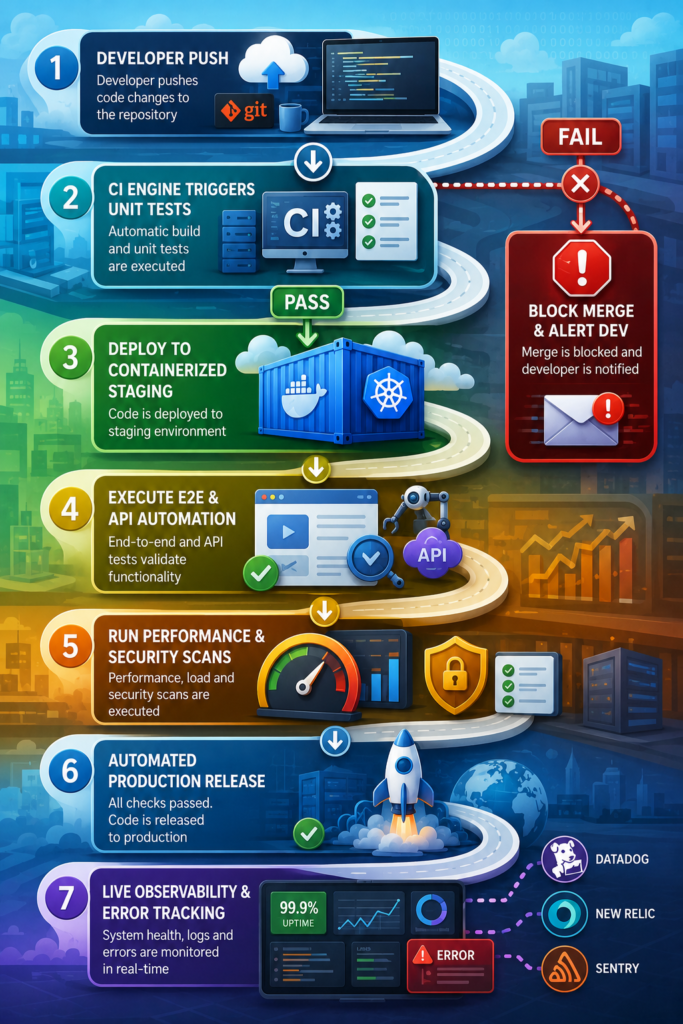
The process begins when a developer pushes a code update to the shared repository, which automatically triggers the CI engine to run localized unit tests. If any test fails, the pipeline immediately stops and alerts the developer.
If the unit tests pass, the system automatically builds and deploys the new code to an isolated, containerized staging environment that mirrors production configurations. The automation framework then runs the complete suite of functional, API, and cross-browser user interface tests.
For updates that alter core database structures or network routing, the system runs automated load simulations and security scans to verify that system limits remain secure. Once every validation gate reports a successful pass, the release engineer approves the build for production rollout. Live monitoring tools like Datadog or Sentry then track the update to catch any subtle anomalies before they affect users.
Common Challenges in SaaS Testing
Even with advanced automation tools, managing quality control across distributed cloud networks presents complex engineering challenges that do not exist in traditional desktop software testing.
Modern QA teams must navigate several unique technical hurdles:
1. Managing Frequent Code Releases
When an application updates multiple times a day, maintaining automation scripts becomes highly demanding. If a developer subtly alters a button ID or shifts a navigation menu layout, automated UI scripts can break, leading to false positives that stall the release pipeline. Teams must design robust, self-healing selectors to prevent test suites from slowing down deployment speeds.
2. Complex External API Integration Depended Systems
SaaS applications are deeply intertwined with external web services like Stripe for billing processing or Salesforce for customer data syncs. When a third-party sandbox platform goes offline or changes its API payload structure without warning, it can break the staging pipeline. QA engineers must use advanced mocking frameworks to simulate these external APIs, isolating their tests from external internet disruptions.
3. Multi-Tenant Data Isolation and Consistency
In a multi-tenant database configuration, multiple companies share identical database tables using unique tenant ID filters. Testing must verify that a query executed by Tenant A can never read, modify, or delete data records belonging to Tenant B.
Simulating massive database read/write actions from thousands of concurrent virtual tenants is essential to prevent severe data cross-contamination incidents.
Best Practices for SaaS QA Success
Building a highly reliable cloud platform requires shifting away from manual quality checks toward a modern, automated engineering framework.
To keep software stable as features evolve, organizations follow these core best practices:
- Automating Critical User Flows Immediately: Manual regression testing cannot keep pace with rapid cloud deployment loops. Focus automation efforts on mission-critical paths like user sign-ins, billing modules, and data exports.
- Adopting a Shift-Left Testing Strategy: Involve QA engineers in early product design phases to identify architecture flaws and catch bugs before any code is written.
- Keeping Staging Environments Synced to Production Data: Ensure staging databases replicate the size and complexity of production environments to prevent bugs that only surface under heavy data loads.
- Deploying Continuous Production Monitoring: Use real-time monitoring tools to capture and log errors as soon as they happen, allowing teams to patch issues before users can file a bug report.
- Maintaining High Integration Test Coverage: Focus testing efforts on the connection points between microservices and external APIs, where complex data transfers are most likely to fail.
Importance of QA in SaaS Success
In the cloud software industry, software quality is closely tied to overall business revenue. Because customers pay for software via ongoing monthly or annual subscription models, software bugs can cause users to immediately cancel their accounts and switch to a competitor.
A robust, automated QA framework directly impacts key business metrics:
- User Retention Rates: Minimizing application crashes keeps users satisfied and prevents customer churn.
- Infrastructure Reliability: Early load testing prevents costly system blackouts during high-traffic business events.
- SLA Compliance: Regular uptime validation ensures the platform consistently meets its contracted service availability targets.
- Brand Trust: Delivering stable, bug-free updates builds customer confidence and enhances market reputation.
Investing in a modern, automated QA architecture transforms software testing from an expensive operational bottleneck into a core competitive advantage.
Frequently Asked Questions (FAQs)
What is SaaS testing?
SaaS testing is the specialized process of validating a cloud-hosted application to ensure it executes reliably across web layers, cloud hosting infrastructure, API endpoints, and variable browser configurations under multi-tenant conditions.
What is QA testing in SaaS development?
It is a continuous, automated engineering discipline integrated directly into the development pipeline. It focuses on preventing bugs before production by running automated code, API, and user interface checks every time software changes are made.
Why is SaaS testing important?
Because cloud platforms serve thousands of corporate clients simultaneously from shared server clusters, a single unverified code error can cause an immediate system-wide outage, resulting in data exposure, compliance violations, and subscriber cancellations.
What tools are used for SaaS testing?
Modern engineering teams use browser drivers like Playwright, Cypress, and Selenium; API diagnostic tools like Postman; load generators like JMeter and Gatling; and live application monitoring platforms like Datadog and Sentry.
How is SaaS testing different from traditional software testing?
SaaS testing requires continuous validation inside rapid release pipelines to manage cloud infrastructure dependencies and multi-tenant data isolation, whereas traditional software testing relies on static validation schedules prior to physical shipping.