
Small businesses lose up to 8% of their revenue to IT downtime every single year. Because of this, traditional servers in office closets are dying out fast. In 2026, over 85% of small firms have moved away from local-only storage. Instead, they need systems that are fast, safe, and affordable. That is why hybrid cloud computing for small business is now the top choice for growing companies.
This guide will show you how to blend public and private systems. You will learn the exact steps to scale your business without spending too much money.
What Is a Hybrid Cloud?
Simple Definition of Hybrid Cloud
A hybrid cloud mixes different computing environments together. It connects local servers or private networks with big public cloud systems. This setup lets them share data and apps smoothly.
How Hybrid Cloud Works
Think of it like a house with a secure safe inside and a public porch outside. You keep your most valuable jewels in the indoor safe. You put your lawn chairs on the public porch where anyone can see them.
Data moves between these two areas using encrypted tunnels. The two systems talk to each other constantly. This setup gives you one unified network.
Key Components of a Hybrid Cloud Environment
- Private Cloud: This is a dedicated network just for your company. It can sit right inside your office building. You can also rent a private space from data centers like Equinix.
- Public Cloud: These are massive computing platforms shared by many users over the open internet. Examples include Amazon Web Services, Microsoft Azure, and Google Cloud.
- Networking Layer: This connects your private and public setups together. It uses Virtual Private Networks (VPNs) or dedicated leased lines to keep data moving safely.
- Management Tools: This is the software dashboard your IT team uses. It lets them control both clouds from one single screen.
Hybrid Cloud vs Public Cloud vs Private Cloud
Public Cloud
Public cloud is owned by third-party tech giants. You share the underlying hardware with other companies. It is cheap and easy to scale up quickly. However, you have less control over where your data actually sits.
Private Cloud
Private clouds belong entirely to your small business. No one else shares your hardware. This gives you total control over security and compliance. The downside is that it costs a lot of money up front to buy the gear.
Hybrid Cloud
The hybrid model combines the best parts of both options. It gives you the high security of a private cloud. It also gives you the massive power and cheap storage of a public cloud.
Which Option Is Best for Small Businesses?
Most small businesses should choose the hybrid option. It keeps your costs down while protecting your vital customer files.
| Feature | Public Cloud | Private Cloud | Hybrid Cloud |
| Upfront Cost | Very Low | Very High | Moderate |
| Security Control | Shared | Maximum | Flexible & High |
| Scalability | Instant | Slow & Costly | Instant |
| Maintenance | None for you | High | Shared |
Why Small Businesses Are Choosing Hybrid Cloud in 2026
Rising Data Security Requirements
Cyberattacks against small firms jumped by 32% over the last year. Hackers know that smaller businesses have weaker defenses. A hybrid setup lets you lock away financial data in your private zone.
Increasing Remote Workforce Demands
Most small businesses now employ remote workers. Employees need to grab files from anywhere at any time. Public cloud apps allow easy access, while the hybrid link keeps company networks safe.
Need for Greater Business Agility
Markets change fast today. If you need to launch a new app, you cannot wait weeks for new hardware to ship. The hybrid cloud lets you launch new customer tools in minutes.
Growing AI and Data Processing Requirements
Small companies now use AI tools to chat with customers and track sales. These smart tools require heavy computing power. You can use public cloud processors to run AI without buying expensive computers.
12 Benefits of Hybrid Cloud for Small Businesses
1. Lower IT Costs Without Sacrificing Performance
You do not need to buy huge servers that sit idle most of the year. This shifts your budget from big hardware purchases (CapEx) to monthly operational fees (OpEx).
Expert Insight: I always tell small business owners to use FinOps practices. FinOps tools track your cloud spending automatically so you never get a surprise bill at the end of the month.
2. Scalability on Demand
Imagine running a flower shop during Valentine’s Day. Your website traffic shoots up by 500% for just three days.
Normal Day Traffic > Handled by Private Cloud
Holiday Traffic Spike > Bursts into Public Cloud automatically
This is called cloud bursting. It keeps your site online during major sales spikes.
3. Enhanced Data Security
You can keep your proprietary code and customer records on your private servers. Meanwhile, you can run your public website on Azure. You get to use Microsoft’s multi-billion dollar security setup for your public face.
4. Better Regulatory Compliance
Small businesses must follow strict rules like GDPR for privacy or HIPAA for medical data. The Flexera 2024 State of the Cloud Report shows that compliance is a top driver for hybrid adoption. It lets you store data in specific geographic zones to meet sovereignty laws.
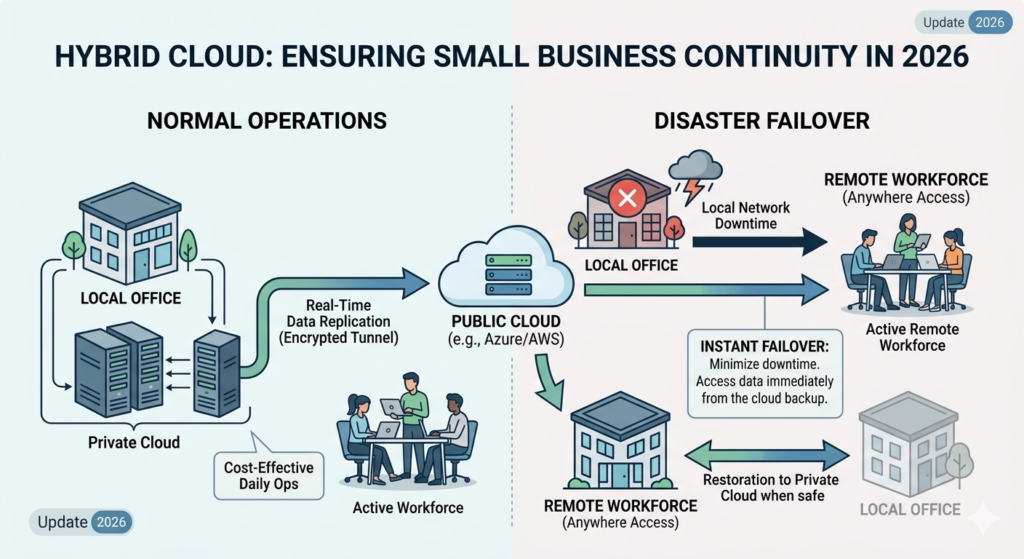
5. Improved Business Continuity and Disaster Recovery
If a storm hits your office, your local servers might lose power. A hybrid setup solves this problem. It backs up your data to the public cloud in real-time. Your team can keep working from home without losing a single file.
6. Greater Flexibility in Workload Placement
Not all business apps are created equal. You can run older inventory software on your local office machines. At the exact same time, you can host your modern customer CRM in the public cloud.
7. Faster Innovation and Time-to-Market
Do you want to test a new online ordering feature? You can spin up a temporary testing site in the public cloud for just a few dollars. If it works, you deploy it. If it fails, you delete it without losing big investments.
8. Support for AI and Advanced Analytics
You can drop massive customer data sets into public cloud tools to find shopping trends. Because the cloud is smart, it processes the data fast. Then, you can save the final reports back down to your secure private system.
9. Improved Employee Productivity
Your team will not waste time dealing with slow VPN connections to the office. Hybrid systems use fast, modern cloud portals. This keeps your remote workers happy and productive.
10. Better Resource Utilization
Old-school offices bought giant servers just in case they grew. Those servers usually sat 80% empty. Hybrid tech ensures you only pay for the exact amount of digital space you use today.
11. Reduced Vendor Dependency
If Amazon raises its cloud prices, you can move parts of your business to Google Cloud instead. You are never trapped by a single tech vendor.
12. Competitive Advantage Against Larger Organizations
You do not need a million-dollar IT budget anymore. Hybrid clouds give small teams access to the exact same tools that Fortune 500 companies use. This levels the playing field completely.
Real-World Hybrid Cloud Use Cases for Small Businesses
Retail and E-Commerce
Local boutique shops use private clouds to store customer credit card details safely. They use public clouds to run their public Shopify storefronts and track global shipments.
Healthcare Practices
Small dental and medical clinics keep patient health records on secure local servers to satisfy laws. They use the public cloud to handle patient scheduling and send out text reminders.
Financial Services Firms
Local accounting firms use hybrid clouds to process tax returns. They keep sensitive financial history locked down on-premise. They use the public cloud to collect digital signatures from clients quickly.
Manufacturing Companies
Small factories use local systems to run their physical assembly line machinery without lag. They use the public cloud to track supply chains and predict when parts will break.
Professional Services Businesses
Law firms use private storage for confidential case files. They use public cloud tools like Microsoft 365 to collaborate on documents with clients daily.
Challenges of Hybrid Cloud Adoption
- Infrastructure Complexity: Managing two different cloud environments takes extra work.
- Security Gaps: If you configure the link between clouds incorrectly, hackers can find a way in.
- Cost Monitoring: Leaving public cloud features running by accident can lead to unexpected bills.
- Skills Gaps: Small IT teams often need extra training to manage advanced hybrid systems.
- Vendor Lock-In: Moving large amounts of data out of certain public clouds can trigger high exit fees.
Best Practices for a Successful Hybrid Cloud Strategy
Start with Business Objectives
Do not buy cloud tools just because they sound cool. Figure out your biggest business problem first. Are you trying to save money, or are you trying to stop system downtime?
Classify Workloads Before Migration
Make a list of every app you use. Group them by security risk.
- High Risk: Payroll, customer passwords, legal documents (Keep Private).
- Low Risk: Company blog, public marketing videos, email templates (Go Public).
Build Security into Every Layer
Use multi-factor authentication (MFA) for every single employee account. Encrypt your data while it sits on your drives and while it travels across the internet.
Automate Operations Wherever Possible
Use software to handle routine tasks like data backups. Automation stops human errors, which cause most cloud data leaks today.
Monitor Performance and Costs Continuously
Set up automated alerts on your cloud accounts. If your monthly spending goes $50 over your budget, the system should text you immediately.
Develop a Disaster Recovery Plan
Test your backup systems at least twice a year. Make sure you know exactly how long it takes to restore your systems if your office loses internet access.
How to Move to a Hybrid Cloud Environment
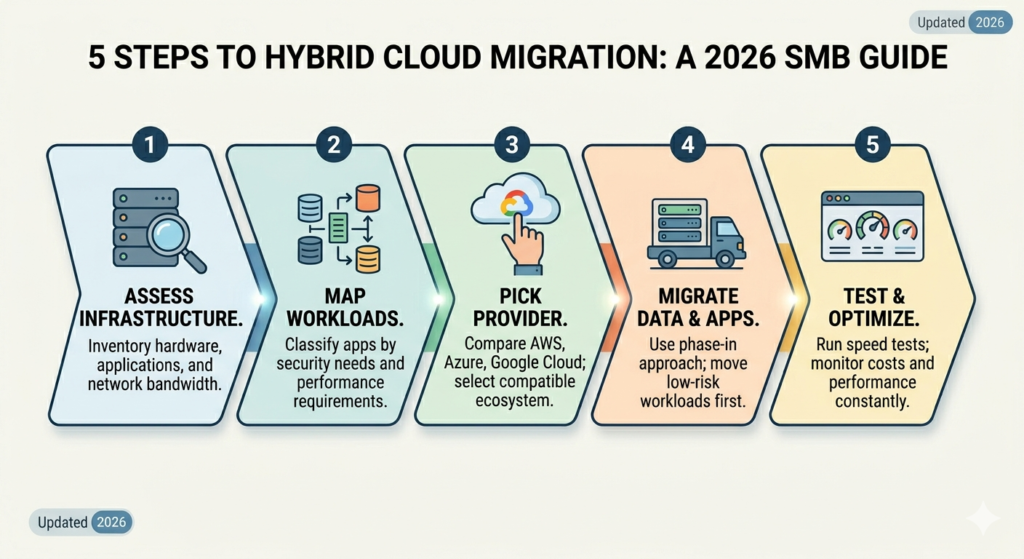
Assess Existing Infrastructure
Count your physical servers and check their age. See how much internet speed your office currently has.
Identify Suitable Workloads
Pick one easy, low-risk app to move first. Moving your company email archive is a great way to start learning.
Select the Right Cloud Provider
Compare options from top vendors. You can check the AWS Small Business Center for starter packages tailored for small teams.
Build a Migration Roadmap
Do not try to move everything over a single weekend. Move one department at a time over a few months to avoid business interruptions.
Test and Optimize
Run speed tests after every move. Ask your employees if their apps feel faster or slower, then adjust your settings.
The Future of Hybrid Cloud
AI-Driven Cloud Management
Soon, smart AI assistants will manage your hybrid networks. They will automatically move data to the cheapest cloud patch to save you money.
Edge Computing Integration
Edge tech processes data closer to where your customers are. This means retail websites will load even faster on mobile phones.
Industry-Specific Sovereign Clouds
More cloud providers are opening specialized platforms. These systems come pre-built to match strict local laws automatically.
Multi-Cloud Hybrid Architectures
Small businesses will soon split work across three or four different cloud providers seamlessly. This will prevent any single point of failure.
Frequently Asked Questions
What is the biggest advantage of hybrid cloud?
The top benefit is total flexibility. You get to choose exactly where your data sits based on your current budget and security needs.
Is hybrid cloud expensive for small businesses?
It requires some upfront costs for setup, but it saves you money over time. You stop paying for massive servers that you do not actually use.
Is hybrid cloud more secure than public cloud?
Yes, because it lets you keep your most sensitive data entirely off the public internet while still using public tools.
Can small businesses use AWS, Azure, or Google Cloud in a hybrid setup?
Absolutely. All three major tech giants offer specific tools designed to link your local office servers to their networks.
How long does hybrid cloud migration take?
For a small business, a proper migration usually takes between one to three months to finish safely.
What industries benefit most from hybrid cloud?
Highly regulated fields like healthcare, finance, legal services, and e-commerce see the biggest benefits from this setup.
Conclusion
Smart business owners know that technology must grow alongside their customer base. Adopting hybrid cloud computing for small business fixes infrastructure headaches before they hurt your profits. While setting up a mixed environment takes careful planning, the benefits outweigh the initial hurdles. This framework gives you enterprise-grade power on a small business budget, turning your IT setup into a tool for real business growth.